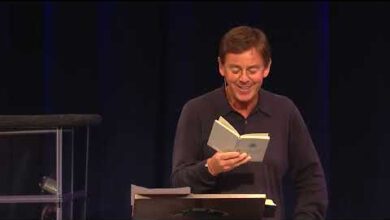
Alistair Begg : Enlightened Together: A New Ministry
Discovering the Unity and Purpose of the Church: A Christian Reflection on Ephesians 3
Throughout history, humanity has longed for unity, peace, and a world made whole. From the dreams of artists to the proclamations of world leaders, the idea of a harmonious global community is not new. Yet, as believers, Scripture offers us a unique perspective on how this deep longing is satisfied—not by human effort alone, but through God’s eternal plan in Christ. Let’s explore these profound truths together as we meditate on Ephesians 3:1–13.
The Enduring Human Search for Harmony
Consider the visions of well-known figures—Winston Churchill, John Lennon, Michael Jackson, and others. Each sought, in their own way, a world where barriers fell and people lived in peace. Lennon’s “Imagine,” the Coke ad “I’d Like to Teach the World to Sing,” and the anthem “We Are the World” all echo a universal yearning for something better than the divisions and brokenness we see today.
Organizations like the United Nations were born out of this hope, declaring their mission to establish international peace and harmony. Yet, a quick glance at the news reminds us that the world’s brokenness persists. Christopher Ash, in his book “Remaking Our Broken World,” points out that all human attempts at community are fragile unless God Himself intervenes and restores what is broken.
Paul’s Life as a Model of Transformation
In Ephesians 3, the Apostle Paul stands as a living testimony to God’s redeeming power. Once a zealous persecutor, Paul’s encounter with Christ turned his life “right side up.” As he writes to the Ephesian church and believers everywhere, he reveals a truth far more profound than anything this world can produce: while earthly unity repeatedly fails, Christ unites all things in Himself—across boundaries, cultures, and generations.
Paul’s message centers on the church, a new community where the fractured world glimpses God’s ultimate design for unity. This church, called the “household of God,” is not just a collection of individuals; it is the family loved by the Father, the very place where He dwells.
From Suffering to Stewardship: Paul’s Perspective
Despite being imprisoned in Rome, Paul doesn’t identify merely as a Roman prisoner but as a prisoner of Christ for the sake of the Gentiles. He sees himself as a steward, entrusted with God’s grace to make the gospel known. Paul’s commission was not self-promotion but service, shaped by divine calling and sustained by grace.
His preaching to the Gentiles—proclaiming their full inclusion in God’s promises—stirred intense reaction from those who clung to old divisions. Yet, Paul’s suffering is presented not as defeat but as part of God’s sovereign plan, and he encourages others not to lose heart because of his trials.
The Unveiling of God’s Mystery
Paul calls what has been revealed a “mystery”—not a puzzle to unravel by our efforts, but a truth once hidden and now made known through divine revelation. This mystery is profound: the Gentiles are now fellow heirs, united with Jewish believers in one body, sharing every blessing through Christ. What was once unthinkable and impossible by human standards becomes reality through the gospel.
This isn’t a blending or simple merging of old identities, but the creation of something brand new. As Ephesians 2 declares, Christ “creates in Himself one new humanity”—a third race, neither Jew nor Gentile, but made one in Him. This unity is not external or superficial; it’s a work of the Spirit, building one new redeemed community destined for eternity.
The Church: Glimpsing the Future Today
Where do we see this reality today? In the church. The church is the stage on which God’s wisdom, love, and power are displayed to the world—and even to the heavenly realms. What happens within the local congregation may seem ordinary, but spiritually it’s extraordinary. Church is far more than tradition; it’s the pilot project, the DNA of the reconciled, restored universe to come.
Each local congregation, whatever its context, is meant to be a living picture of the future God has promised—a diverse, reconciled, worshiping community, unified not by worldly similarities but by God’s grace. Sometimes, this feels imperfect and incomplete, but even our imperfect gatherings provide glimpses of glory and hope for what is to come.
The Role of Preaching and Proclamation
Paul’s call was to preach “the unsearchable riches of Christ.” Whether to Gentiles, to all people, or—astonishingly—to angelic powers, the message rings out: in Christ, God is mending what was shattered. Preaching, then, is not just a human act but a divine encounter, where, through frail voices, the Holy Spirit makes Christ known to hearts. While we are all “nothing” as human messengers, God is everything, and the focus remains on Christ and His finished work.
The gospel message is both particular and universal: offered freely to all, yet powerful to transform anyone who responds in faith. When we lose sight of the grandeur and scope of the gospel, our zeal for sharing it dims. But as we rest in its glory—that Christ is gathering a people from every background into one body—our vision and our mission grow bold.
Cosmic Implications: The Church as a Display of Wisdom
Perhaps most astonishing, Paul reveals that what God is accomplishing in the church is not only a witness on Earth, but a proclamation to the cosmic powers. The “manifold wisdom of God” is put on display, not just to people but to angels—both good and evil. Through the church, the victory of Christ is announced, the enemy’s defeat declared, and heaven rejoices at the mystery