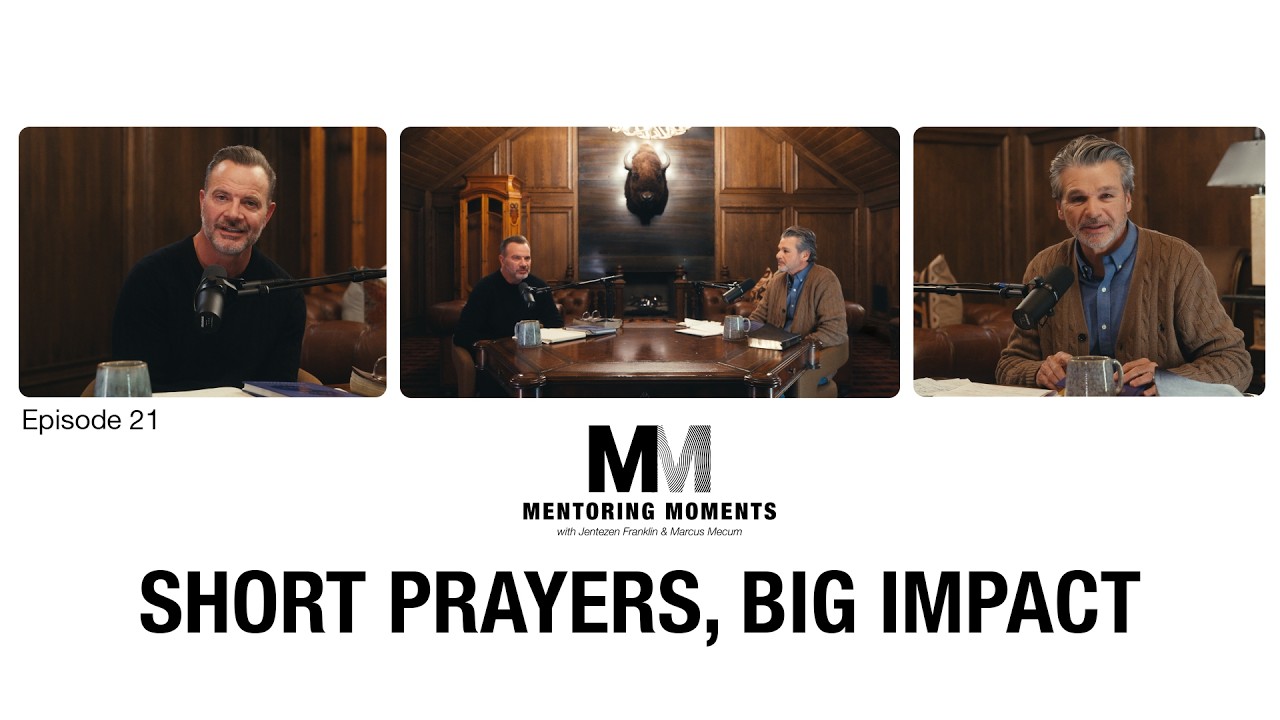
Jentezen Franklin: Mentoring Moments | EP 21: Short Prayers, Big Impact
In this episode of the Mentoring Moments podcast, Pastor Jentezen Franklin sits down with his longtime friend and mentee Marcus Mikum to talk about a subject that has shaped his entire ministry: short prayers Jentezen Franklin has prayed faithfully for nearly four decades. Recorded at a newly dedicated ranch property in Georgia, the conversation moves from a vision for refreshing weary pastors to the quiet discipline of meeting God in a regular place of prayer, and finally to the ancient priestly blessing found in the book of Numbers.
Video Summary
The episode opens with Marcus Mikum explaining why Mentoring Moments exists. For more than twenty years he has spoken with Pastor Franklin almost every Saturday, and those private conversations shaped both his life and his church. The podcast is an attempt to share that kind of behind-the-scenes mentoring with leaders who do not have a personal phone line to an experienced pastor.
Franklin then describes the property where they are sitting, a 500-acre ranch that was donated to the ministry. He shares that the season of his life has changed: after years of traveling and preaching around the world, he now feels drawn to pour into a smaller number of leaders, following the pattern of Jesus, who taught the multitudes but repeatedly returned to the twelve to explain what He meant. The ranch, named Shiloh Ranch, is intended as a place where pastors and their spouses can come for a few days of rest, honest conversation and renewal.
The name carries a story. Franklin recounts the Civil War battle of Shiloh, where tens of thousands of soldiers fell. He describes the historical account of the so-called angel glow, when some wounded soldiers lying in pools of water near the river were observed to glow faintly at night and recovered far better than others. Later research attributed the glow to bacteria that helped fight infection. For Franklin, the image speaks of God bringing healing to wounds that look irreparable, and he hopes the ranch will be a place where peace returns to war-torn families, marriages and ministries.
The second half of the conversation turns to prayer. Mikum asks about Franklin’s book on short prayers, and Franklin explains that it grew out of messages that became more than sermons; they became daily prayers he has repeated for decades. He closes by unpacking the priestly blessing of Numbers 6, a prayer God Himself gave to Aaron and his sons to speak over His people.
Key Takeaways
- Mentoring often happens best in small, consistent, behind-the-scenes conversations rather than large public events.
- Jesus modeled ministry to multitudes while investing deeply in a few disciples.
- Short, Scripture-based prayers repeated faithfully over many years can carry great spiritual weight.
- God waits for His people in the place of prayer; showing up consistently matters more than eloquence.
- Prayer creates a spiritual atmosphere over churches, families and worship.
- The priestly blessing of Numbers 6 is a God-given prayer that believers can speak over their children and households.
A Vision for Refreshing Pastors
Franklin is candid that the pressures of ministry can leave leaders isolated, with no one to talk to about the struggles that happen behind the pulpit. He describes the dream for Shiloh Ranch as a table where pastors can sit down, reason together and perhaps find a reason not to quit. He emphasizes that the gatherings will be small, around twenty to forty people, so that real relationships can form.
He also shares an encouragement for leaders in small towns. His ministry began in Gainesville, Georgia, not in a major city, yet God used it to reach people around the world. In his view, when something grows from a small place and touches many lives, that is clear evidence of God at work. Mikum adds that places matter to God; while people are what truly count, the Lord can anoint a location where burdens lift and dreams are renewed.
Leaders who want more of Franklin’s perspective on caring for hurting people may find his earlier conversation helpful: Pastoring People Through Pain.
Why Short Prayers Matter
According to Franklin, his book on short prayers is the most personal thing he has written. Each chapter grew from a message that, as he puts it, became engrafted into him, much like a branch grafted onto a tree that begins to bear fruit. He memorized brief prayers drawn directly from Scripture and returned to them again and again, often without realizing how much God was leading him in that repetition.
He is clear that the emphasis on short prayers is not meant to discourage long seasons of prayer. He describes walking or running the trails of the property for an hour and a half at a time, praying over the land and the people on his heart. But those long times, he says, usually begin with one of these simple, biblical prayers. As he prays through a familiar thought, he eventually hits a vein and senses the Holy Spirit leading him further.
Franklin reflects that looking back, he believes many things he now sees would not exist if he had not prayed those prayers for years. He admits he has failed in various ways as a leader, but he has never lost his passion for prayer. When he goes a day or two without his prayer place, he feels it, as though he is missing a friend who has been waiting for him.
God Waits in the Place of Prayer
One of the most memorable images in the episode is Franklin’s description of God waiting for His people. He compares it to Mikum keeping an appointment with him even after preaching four services and feeling unwell, simply because he did not want to leave his friend waiting. In the same way, Franklin says, the Lord meets those who make a habit of showing up in a set place and time.
He connects this to the experience of Isaiah, when a coal from the altar touched the prophet’s lips and transformed his ability to speak (see Isaiah 6:6-8). Prayer, he says, is what turns a sermon from mere words into something with power behind it. It creates an atmosphere over churches and worship services, and its absence creates an atmosphere too. People who pray carry a noticeable force because they have spent time with the Lord.
Franklin also points to the story of the paralyzed man lowered through a roof by his friends. Scripture says Jesus saw their faith (Mark 2:5). He believes that when believers pray biblical prayers with authority, drawn from years of faithful practice, God responds to that faith. He shares that he has prayed one particular prayer from his book over many church members facing a difficult diagnosis.
The Priestly Blessing of Numbers 6
Mikum recalls a morning conversation over coffee in which Franklin explained the Aaronic blessing, and he asks him to share it. Franklin believes every Christian should memorize this passage. He notes that it was not Moses’ idea or Aaron’s inspiration; God Himself gave the words and commanded the priests to speak them over the people for generations (Numbers 6:22-27).
He describes the blessing as a song in three stanzas, each building on the last: the Lord bless you and keep you; the Lord make His face shine upon you and be gracious to you; the Lord lift up His countenance upon you and give you peace. Franklin began praying it over his own life about forty years ago and later over his children and grandchildren every day.
He admits that in the church culture he grew up in, repeated prayers were sometimes looked down on, even the Lord’s Prayer, as though repetition meant a lack of sincerity. Over time he came to see that when God gives exact words and tells His people to pray them over their families, those words deserve careful attention. He explains that the Hebrew idea behind blessing carries the sense of God bending low toward His people, a picture of a King stooping to show favor.
For another message in which Franklin speaks about God’s care for families and future generations, see Generational Garments.
Frequently Asked Questions
What is the main message of this Mentoring Moments episode?
The episode focuses on the power of short, Scripture-based prayers prayed consistently over many years, along with Jentezen Franklin’s vision for a ranch where pastors can be refreshed and mentored.
Why is the ranch called Shiloh?
Franklin connects the name to the biblical meaning associated with peace and to the Civil War battle of Shiloh, where the angel glow story became, for him, a picture of God bringing healing to deep wounds.
What prayer does Jentezen Franklin recommend memorizing?
He encourages believers to memorize the priestly blessing in Numbers 6:24-26 and to speak it regularly over their children, grandchildren and households.
Final Thoughts
This conversation offers a warm and practical look at the inner life of a long-serving pastor. Jentezen Franklin does not present prayer as a technique reserved for the super spiritual, but as a faithful habit of showing up where God is already waiting. Short prayers drawn from Scripture, repeated through every building program, family crisis and hospital visit, have become the foundation of his ministry. Whether listeners are pastors looking for encouragement or believers wanting a deeper prayer life, the episode invites them to choose a place, keep the appointment and let simple biblical prayers grow into lasting fruit.
