Shift Your Life by Changing This One Thing | Sarah Jakes Roberts Sermon
In a teaching about personal transformation, Sarah Jakes Roberts explains how to shift your life by focusing on the one thing believers can actually control: who they are becoming in the presence of God. Rather than urging people to change cities, churches or jobs, she argues that real change begins on the inside, and that when a person shifts, the environment around them shifts as well.
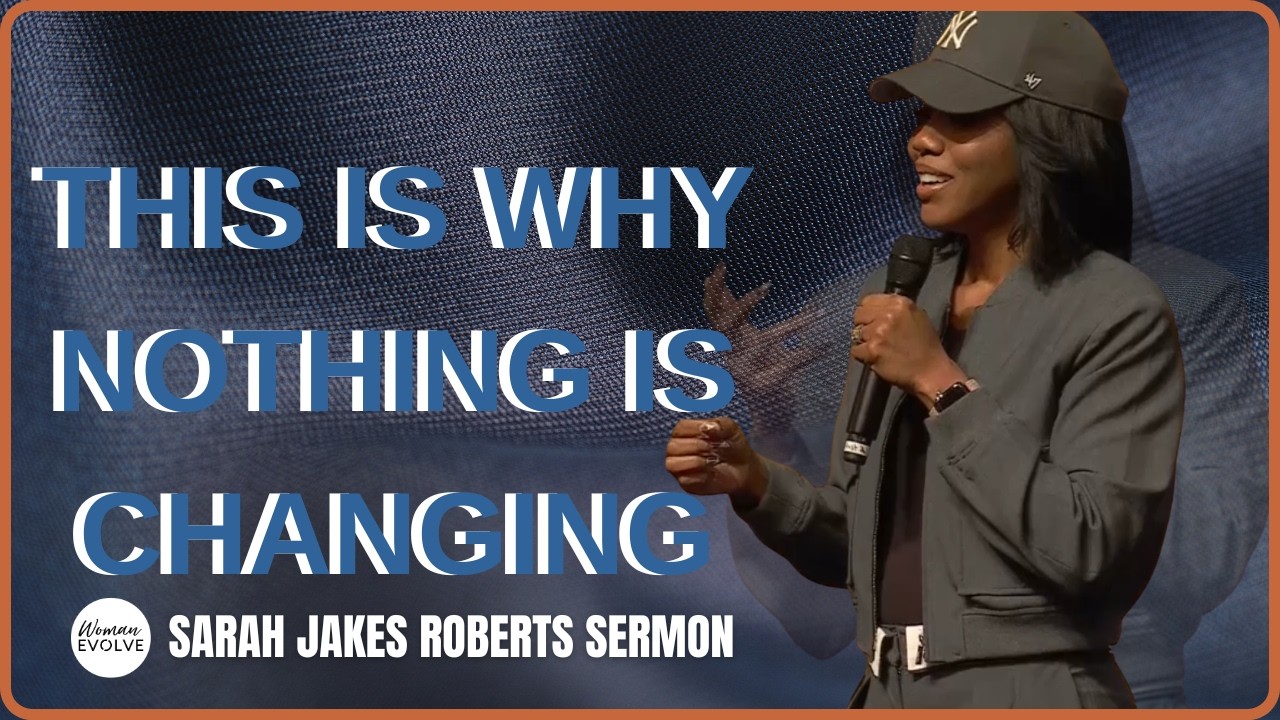
Video Summary
Sarah Jakes Roberts opens by describing discipleship as a willingness to lay down anything that does not line up with God’s truth about who we are. She notes that many people cannot simply “be themselves,” because the self they have become was shaped by brokenness, trauma, shame and the habits of their families and communities. Presenting ourselves as living sacrifices, she says, means asking the Lord to highlight every pattern that keeps us from wholeness.
She then points out that God does not always reveal those patterns in a quiet prayer closet. Often He uses correction and the friction of relationships. Not everyone who challenges us is a hater, she says; some people are mirrors showing us harmful behaviors we have come to call natural. In seasons of conflict, she encourages listeners to ask whether something in them is contributing to the problem instead of assuming the fault lies only with others.
From there she turns to the story of the young Jesus in the temple and to the account of Hannah, using both to show how God develops people through submission, prayer and a changed heart. The message closes with a prophetic encouragement that God wants to use ordinary believers as living examples, showing their families and circles that there is another way to live.
Key Takeaways
- Discipleship includes laying down habits and mindsets that do not agree with God’s word, even when they feel natural.
- God often reveals our blind spots through correction and the people around us, not only through private prayer.
- Like Jesus at twelve, believers sometimes have to submit to environments that develop their weaknesses rather than showcase their strengths.
- An environment is not always a location; changing cities or jobs will not help if we carry the same issues with us.
- When a person shifts their heart, language and thinking toward God, their relationships and atmosphere begin to shift too.
- Instead of asking “Where am I supposed to be?” Roberts encourages asking “Who am I supposed to be?”
Letting God Highlight What Needs to Change
The starting point of this message is honesty. According to Roberts, nobody grows up in this world without taking on some of its shape. The thoughts, reactions and behaviors that are accepted in a family or community can feel normal, yet they may be the very things God wants to remove. That is why she connects the idea of transformation with Romans 12:1-2, where believers are urged to present their bodies as living sacrifices and to be transformed by the renewing of their minds.
She describes this kind of surrender as a prayer: Lord, anything in me that does not look like You, show it to me. The surprising part, she says, is how God answers. Sometimes He whispers. More often, He lets us see how our way of showing up affects someone else. A difficult conversation, a strained relationship or a repeated conflict can become a mirror. Roberts challenges listeners not to dismiss every critic, because seeing poison in another person does not mean there is none in us.
Jesus in the Temple: Submitting to Be Developed
To illustrate growth that feels unnatural, Roberts turns to Luke 2:46-52. At twelve years old, Jesus stays behind in the temple, listening to the teachers, asking questions and amazing them with His understanding. When Mary and Joseph find Him after three days of searching, He asks why they did not know He would be in His Father’s house.
What stands out to Roberts is what happens next. Jesus was clearly operating in what came naturally to Him, yet He went home and was subject to His parents, even though they did not fully understand Him. She sees this as a picture of development: God sometimes places us in environments that do not celebrate our strengths so that we can grow in areas where we are weak. If we resist those seasons because they make us feel inadequate, she warns, we may miss the fullness of who God wants us to become.
She ties this to Paul’s instruction in Philippians 2:5-8, where believers are told to have the same mind that was in Christ Jesus, who humbled Himself. Humility, in her view, is the willingness to be developed rather than simply affirmed.
Your Environment Is Not Always a Location
Much of the sermon addresses questions Roberts received about changing environments. She acknowledges that sometimes God does lead people to a new city, job or church. But she observes that many people move and still face the same problems. The new job brings the same frustrations; the new relationship produces the same results. In those cases, she suggests, the issue is not the location but something being carried from place to place.
Here she points to Hannah in 1 Samuel 1. Hannah remained in the same household, with the same rival and the same circumstances, yet something changed when she poured out her heart before the Lord. Her situation did not transform instantly, but she left the presence of God different, and she re-entered her environment with a new posture. Roberts summarizes it this way: you can shift your environment without changing your circle when you change the way you show up in that circle.
She says she sensed God emphasizing that believers have the ability to create an atmosphere. When someone partners with God, it affects their language and their thinking, and that inevitably affects their relationships. Some people will drift away, and others will be drawn closer. The key, she insists, is to focus on personal change and let God rearrange what surrounds it.
Asking “Who Am I Supposed to Be?”
One of the most quotable ideas in the message is the call to stop asking where we are supposed to be and start asking who we are supposed to be. Roberts explains that when a person becomes who God designed them to be, God takes care of the doors, opportunities and connections. She echoes the promise of Revelation 3:7-8 about doors no one can shut and doors no one can open.
She describes her own experience of ending up in rooms she never expected to enter, and says there was no secret strategy behind it. She simply began to hunger and thirst for righteousness, a phrase drawn from Matthew 5:6. That hunger showed up in how she thought and what she created, and as it did, things around her began to shift. Her encouragement is to make the relationship with God personal: not only asking Him to reveal what needs to change, but also asking Him to show how to change it and who might hinder that growth.
Becoming a Light in Your Circle
Roberts closes by offering a simple test for any environment: Who do I become here, and who do others become because I am here? Rather than only asking what a place does for us, she asks what we add to it. If God has placed a desire for change in someone, she says, it may be because He wants that person to carry it, not wait for someone else to lead with integrity.
She shares a personal story from a time of transition in Dallas, when she worried that ministry might cost her family, her health or her marriage. A word of encouragement from a fellow minister assured her that she would be well, so that others could see it is possible to serve God and stay whole. Roberts extends that same encouragement to her listeners: God may want to use them as a sign and a model, showing their families a healthier way to think, spend, build and live. That idea fits the spirit of Matthew 5:14-16, which calls believers the light of the world.
For more teaching in a similar vein, readers may appreciate Stop Letting Your Environment Kill What God Put In You and God Is Preparing You in Secret, both from Sarah Jakes Roberts.
Frequently Asked Questions
What is the “one thing” Sarah Jakes Roberts says can shift your life?
According to Roberts, the one thing is yourself: your heart, your thinking and the way you show up. She teaches that when a person shifts toward God, the environment around them begins to change as well.
Does she say people should never change their environment?
No. She acknowledges that God sometimes leads people to a new place, but she warns that moving without inner change often produces the same results in a new setting.
Why does she use the story of Jesus in the temple?
She uses Luke 2 to show that even Jesus submitted to an environment that did not fully understand Him, illustrating that God often develops our weaknesses in places that do not showcase our strengths.
Final Thoughts
This message from Sarah Jakes Roberts is a practical invitation to stop waiting for circumstances to change and to begin with personal surrender. By letting God highlight hidden patterns, accepting seasons of development and asking who they are meant to become, believers can experience lasting transformation. As Roberts puts it in her own way, when you shift, God will take care of shifting the rest.
