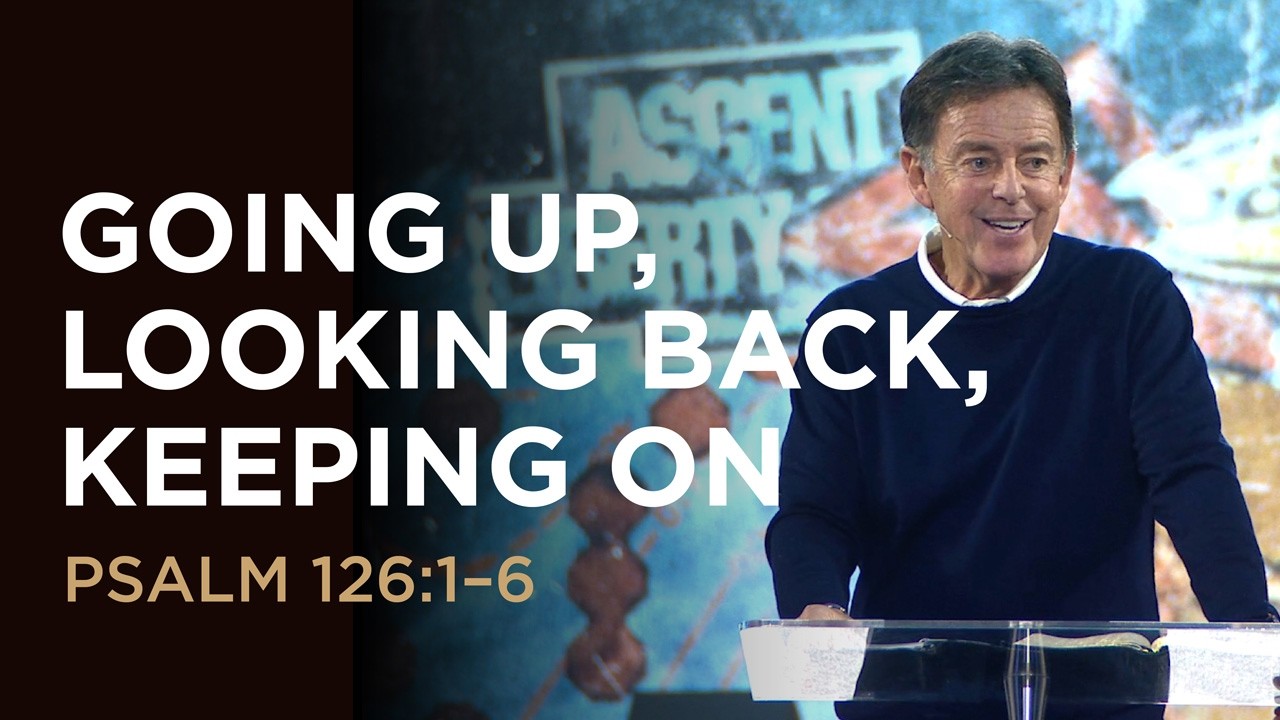
Alistair Begg: Going Up, Looking Back, Keeping On
In this warm and searching message, Going Up, Looking Back, Keeping On Alistair Begg walks through Psalm 126, one of the Songs of Ascents that pilgrims sang on their way to Jerusalem. Using three simple phrases, the Truth for Life pastor shows how a short ancient song speaks directly to believers today: we are people who remember what God has done, who keep praying and working for more, and who look ahead to a final homecoming.
Video Summary
Begg opens by reflecting on the unusual place of singing in the Christian faith. Many religions chant or recite, he observes, but the people of God have always sung, from the song of Moses and Miriam to the Psalms. He reminds listeners that the Psalms of Ascent were songs Jesus Himself would have known by heart, which makes singing them today a remarkable privilege.
Before turning to the text, Begg offers two interpretive keys. First, the Bible is a book about Jesus: predicted in the Old Testament, revealed in the Gospels, preached in Acts, explained in the letters and expected in Revelation. Second, he borrows B. B. Warfield’s image of the Old Testament as a richly furnished room that is only dimly lit. The New Testament does not replace the furniture; it turns on the lights so the furniture can be seen clearly.
From there he organizes the psalm around three phrases. “Going up” describes the pilgrims’ journey to Jerusalem, which was considered the most important place on earth because God’s presence was symbolized there. “Looking back” covers verses 1 to 3, where the people remember the joy of being restored from exile. “Keeping on” covers verses 4 to 6, where the same people pray for fresh restoration and commit to faithful, often tearful, sowing. Begg closes by pointing forward to Revelation 21 and the new Jerusalem, the ultimate “going up” still to come.
Key Takeaways
- Singing is a distinctive mark of God’s people, and the Psalms of Ascent were songs Jesus Himself sang.
- The whole Bible points to Christ; the New Testament illuminates rather than corrects the Old.
- Remembering past mercies produces gratitude, joy and even laughter among God’s people.
- Disobedience silences genuine worship; it is hard to sing heartfelt praise while resisting God.
- Past blessing should lead to fresh prayer, not nostalgia: “God can do it again.”
- Restoration comes both suddenly, like desert streams, and gradually, like a harvest sown in tears.
- The story is not finished; believers look forward to the new Jerusalem where God dwells with His people.
Going Up: Why Jerusalem Mattered
Begg explains that the pilgrims spoke of “going up” to Jerusalem not because the city sits especially high, but because it was the center of Israel’s worship. The ark and later the temple were there, symbolizing God’s dwelling among His people. It was a place where rival tribes gathered together, where justice was established and where the throne of David stood.
He suggests three words to summarize what Jerusalem represented: intimacy with God, security under His rule and harmony among His people. Yet he acknowledges that the earthly city does not display those qualities perfectly, then or now. That is why the prophets, such as Isaiah in chapter 2, looked ahead to a future fulfillment. Begg compares reading the prophets to hill walking in Scotland: you think you are reaching the summit, only to find the true peak is further on. There are partial fulfillments along the way, but the final one is still ahead.
Looking Back: The Joy of Restored Fortunes
The first half of Psalm 126 recalls a time when the Lord “restored the fortunes of Zion.” The change was so dramatic that the people felt they must be dreaming. Begg places this against the backdrop of Israel’s history of idolatry, rebellion and exile. In Babylon they had hung up their harps, unable to sing the songs of Zion in a foreign land. Then God brought them home, just as He had promised.
Begg draws a personal lesson here. According to him, disobedience and wholehearted praise do not sit comfortably together. When a believer is resisting God’s clear instructions, songs of worship can only be faked. By contrast, when God acts, the mouth is filled with laughter and the tongue with shouts of joy.
He also highlights the order of verses 2 and 3. First the surrounding nations say that the Lord has done great things for Israel; then the people themselves confess it. When the watching world sees God’s people singing with genuine joy, it has no natural explanation. Begg notes that throughout Scripture, from the walls of Jericho to the empty tomb, the clearest works of God are those no one can explain away. He connects this joy to the fruit of the Spirit, a deep gladness that does not depend on changing circumstances. As the apostle Paul writes, the things written in former days were written for our learning, so that we might have hope (Romans 15:4).
Keeping On: Praying and Sowing for More
Begg points out a striking shift between verses 3 and 4. Having just celebrated restored fortunes, the psalmist suddenly prays, “Restore our fortunes, O Lord.” If the first panel of the psalm is about dreaming, he says, the second is about praying. Gratitude for the past does not mean the people of God have arrived; there is always more of His grace to know and more of His goodness to show to others.
He describes two ways restoration comes. The first is sudden, like the streams of the Negev. Dry desert gullies can fill almost instantly when rain falls, and in the same way God can refresh a weary soul or congregation overnight. Begg links this to Jesus’ promise that rivers of living water would flow from those who come to Him.
The second way is gradual. “Those who sow in tears shall reap with shouts of joy” (Psalm 126:5-6). A farmer cannot simply sit and wait for God to produce a harvest; he must rise early and sow the seed, even when he does not feel like it. Begg insists that steady, persistent, undramatic faithfulness is a normal part of the Christian life. No single experience lifts a believer permanently above trials and temptations on this side of heaven.
Applying the Psalm Personally, Congregationally and Nationally
Begg applies the pattern of remembering and praying at several levels. Personally, every Christian can look back on conversion, when God brought them out of bondage and put a new song in their heart, and still ask for fresh grace. Congregationally, many churches have known seasons of blessing that later faded, and they rightly pray for renewal.
Nationally, he mentions his native Scotland, once called the land of the book. He recalls that Glasgow’s historic motto once spoke of the city flourishing through the preaching of the word and the praising of God’s name, but the modern version has dropped that reference. For him, this illustrates how a people can drift from a rich spiritual heritage and need to pray for restoration. In mission, too, believers plant and water, but only God gives life to the seed.
The Final Going Up
To answer how the promises about Jerusalem should be understood today, Begg points listeners toward Hebrews 12, where believers are said to have come to the heavenly Jerusalem, and toward Jesus’ statement that His kingdom is not of this world. In his view, the Old Testament’s territorial pictures prepare God’s people for a greater kingdom.
He ends with Revelation 21, where John sees the new Jerusalem coming down from heaven and hears that God’s dwelling is now with His people (Revelation 21:1-3). In that city there is no temple, because the Lord God Almighty and the Lamb are its temple. Begg summarizes the message this way: believers today look back with gratitude, keep on in faithful prayer and labor, and look forward to the day when they will finally go up.
For more teaching from the same preacher, see Alistair Begg: Abounding Hope and Alistair Begg: Create in Me a Clean Heart.
Frequently Asked Questions
What is the main passage in this Alistair Begg message?
The sermon is an exposition of Psalm 126, one of the Songs of Ascents that Israelite pilgrims sang while traveling up to Jerusalem for the festivals.
What are the three points of the sermon?
Begg structures the message around “going up” (the pilgrimage to Jerusalem), “looking back” (remembering God’s past restoration in verses 1 to 3) and “keeping on” (praying and sowing for future blessing in verses 4 to 6).
What does “those who sow in tears shall reap in joy” mean according to Begg?
He explains that spiritual fruit usually comes through steady, persistent and sometimes painful faithfulness. Believers should not merely wait for dramatic intervention but should keep doing what is right, trusting God to bring the harvest.
Final Thoughts
Alistair Begg’s treatment of Psalm 126 offers a balanced picture of the Christian life. It honors the joy of what God has already done, refuses to settle into nostalgia, and calls believers to pray boldly and work patiently. Above all, it reminds listeners that the journey is heading somewhere: toward a city where God dwells with His people forever. Until then, the church keeps singing the songs of Zion with gratitude and hope.