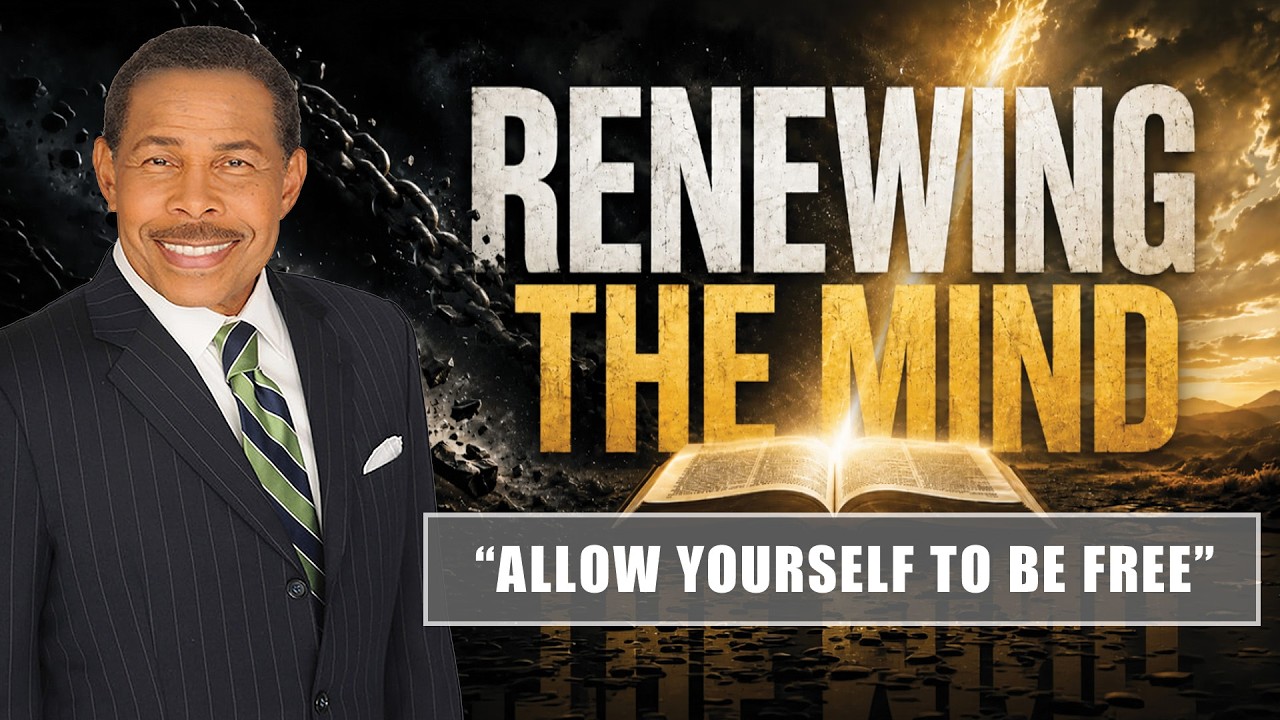
Dr. Bill Winston: Allow Yourself to be Free – Renewing the Mind
Many believers have been forgiven by God yet still live as though their past defines them. In this message from The Believer’s Walk of Faith, Dr. Bill Winston addresses that tension head on. Allow Yourself to be Free Bill Winston teaches that being born again makes a person brand new on the inside, and that renewing the mind is how believers learn to live out that freedom instead of remaining trapped by guilt, condemnation and old patterns of thinking.
Video Summary
Winston begins with the core idea of his renewing-the-mind series: salvation changes the spirit, but the mind still has to be brought into agreement with God. He explains that the mind carries a subconscious set point formed by the past, and that this set point must be reprogrammed with the Word of God.
He walks through Romans 12:1-2, explaining that conformed means to be squeezed into the world’s mold, that transformed comes from the same root as metamorphosis, and that renewing carries the idea of renovating an old house. He mentions that a recent divisive election season, in which he observed believers sharply divided against one another, convinced him that many Christians’ minds have not yet been renewed.
From 2 Corinthians 10 he teaches that the believer’s battle is not in the flesh and that God has given divine weapons to pull down strongholds in the mind. Much of the message then focuses on guilt and condemnation. Using examples from the woman at the well, the woman caught in adultery and the apostle Paul, he insists that a believer’s past is gone and that dwelling on it robs a person of faith.
He closes by describing the mind, will and emotions, and by teaching on the God-given purpose of imagination and vision, using Joseph and Abraham as examples.
Key Takeaways
- A born-again person is a new creation; the old self has passed away.
- Strongholds are patterns of thought, and God’s Word is the weapon that pulls them down.
- Condemnation steals faith, and faith is how believers receive from God.
- When believers stumble, 1 John 1:9 provides cleansing for both sin and a guilty conscience.
- New believers need encouragement and prayer, not judgment from people who seem super spiritual.
- Imagination and vision are God-given tools to see and move toward one’s destiny.
Transformation, Not Conformity
Winston anchors the message in Paul’s appeal to present the body as a living sacrifice and not to be conformed to this world but transformed by the renewing of the mind (Romans 12:1-2). He explains that conformity is the world pressing a person into its shape, while transformation is a metamorphosis like a caterpillar becoming a butterfly.
The process happens through renewal, which he compares to renovating an old house. The structure is kept, but everything inside is updated. In the same way, a believer’s mind is renovated by steadily replacing old beliefs with God’s truth. As he puts it, if a person wants to change his or her life, the starting point is to change the thoughts.
Readers interested in more on this theme can also explore Winston’s related message The Best That GOD Has.
Pulling Down Strongholds
Winston admits he once thought pulling down strongholds meant something dramatic and external. He now teaches that Paul was describing thoughts the enemy stacks up in the mind (2 Corinthians 10:3-5). These might sound like messages that a person is unworthy, that he or she cannot do what others do, or that past failures disqualify him or her.
The answer, he says, is to go to the Bible and discover one’s true identity. Anyone in Christ is a new creation; old things have passed away and all things have become new (2 Corinthians 5:17). He notes that a person’s body does not visibly change at salvation, but the inner person who committed past sins is gone. God made Jesus, who knew no sin, to be sin for us so that believers might become the righteousness of God in Him. Feelings may disagree, but Winston urges listeners to walk by faith rather than by feelings.
Freedom From Guilt and Condemnation
A central point of the message is that many of God’s people cannot walk in deliverance or ministry because they are still dealing with what they did. Winston points to the Samaritan woman at the well, who had been married five times and was living with a man, yet became a witness to her whole town after meeting Jesus. He also recalls the woman caught in adultery, to whom Jesus said that He did not condemn her and that she should go and sin no more.
He highlights the apostle Paul, who once dragged men and women to prison, yet later wrote that he had wronged no one. For Winston, this shows how fully Paul understood that his old life was gone. The enemy constantly tries to remind believers of their past, but God does not. When condemnation remains, it steals faith, and without faith a person cannot receive what God has provided.
He addresses those who fear this teaching gives people a license to sin. Believers still stumble while their minds are being renewed, and God provided for that: if they confess their sins, He is faithful and just to forgive and cleanse them from all unrighteousness (1 John 1:9). The cleansing, Winston says, reaches the mind and memory, washing away guilt and shame through the blood of Jesus.
He also challenges believers who are quick to criticize new converts. Rather than pointing fingers, mature Christians should encourage, pray and even fast for those still learning to walk in freedom. He describes a balanced path of grace between rigid religion and careless living. The way to set someone free, he says, is to let that person be free.
Mind, Will, Emotions and Imagination
Winston describes the soul as having three parts: the mind, which thinks and reasons; the will, which makes choices; and the emotions, which feel. To sustain a decision, he says, it must be anchored in the emotions, and to change feelings, a person must change focus.
He then teaches on imagination, describing it as the ability to see what has not yet appeared in the physical world, sometimes through revelation from God. Where there is no vision, the people perish (Proverbs 29:18). Joseph saw himself ruling before it happened, and God told Abram to look north, south, east and west because all the land he could see would be given to him. Winston’s summary is simple: if a person cannot see it, that person cannot have it.
For more on how Winston connects vision and expectation, see The Source of Your Expectations.
Frequently Asked Questions
What is the main message of Allow Yourself to be Free?
Bill Winston teaches that believers are new creations in Christ and must renew their minds so that guilt and condemnation over the past no longer keep them from walking in faith and freedom.
What are strongholds according to Bill Winston?
He describes strongholds as patterns of thinking the enemy builds in the mind, such as feelings of unworthiness, which are pulled down through the Word of God.
Does this teaching encourage people to keep sinning?
No. Winston points to 1 John 1:9 as God’s provision for cleansing when believers stumble, and he echoes Jesus’ words to go and sin no more, while warning against condemnation that destroys faith.
Final Thoughts
Allow Yourself to be Free is an encouraging message for anyone who has received forgiveness but still feels weighed down by the past. Dr. Bill Winston combines clear Bible teaching with passionate exhortation, reminding believers that their past is under the blood, that God does not bring it up again, and that renewing the mind is the path to living as the new creation they already are. As faith replaces condemnation and vision replaces old memories, believers can step into the destiny God has prepared for them.
