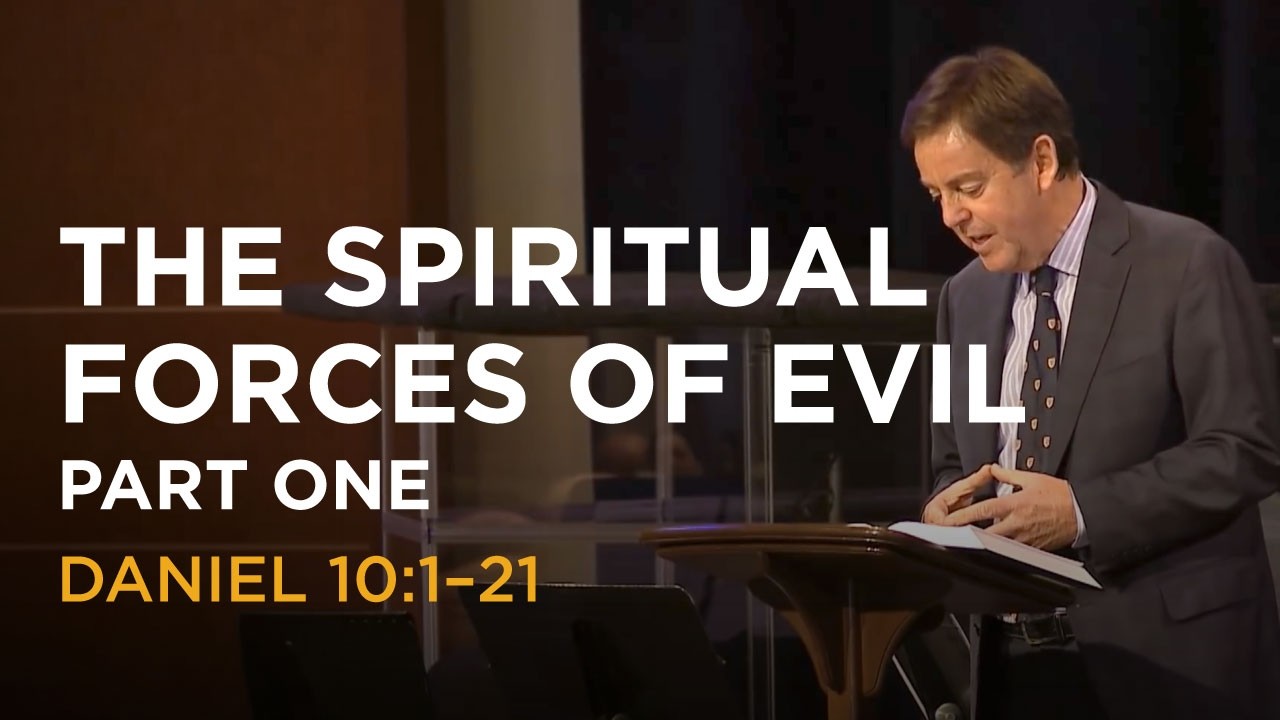
Alistair Begg: The Spiritual Forces of Evil — Part One
In The Spiritual Forces of Evil — Part One, Alistair Begg of Truth for Life opens Daniel 10 to address a question many people ask in times of tragedy: what is wrong with our world? Begg argues that the conflict, brokenness and opposition to Christ seen on earth cannot be fully understood apart from the unseen spiritual conflict the Bible describes. Daniel’s vision, he explains, pulls back the curtain on that reality while pointing believers to the sovereign rule of Christ.
Video Summary
Begg begins by reading Daniel 10, where Daniel, after three weeks of mourning and fasting, receives a vision of a glorious man clothed in linen. The messenger explains that he was delayed for twenty-one days by “the prince of the kingdom of Persia” until Michael, one of the chief princes, came to help him.
Begg connects this passage to the questions many people were asking in the wake of recent violent events in the world: Why is there so much conflict? Why are followers of Jesus so often opposed? When will it end? He explains that the closing section of Daniel, chapters 10 to 12, reveals that what happens on earth is tied to conflict in the heavenly realms. He quotes Abraham Kuyper twice, traces the conflict back to Genesis 3:15, explains Paul’s teaching in Ephesians 6 and begins to examine Daniel’s faithful service late in life.
Key Takeaways
- The brokenness of the world has spiritual roots that the news rarely acknowledges.
- Believers should focus on the major themes of Daniel rather than debatable details.
- World history is best understood through the lens of Scripture.
- Christ is sovereign over every square inch of creation.
- The conflict between good and evil traces back to God’s promise in Genesis 3:15.
- Believers wrestle not against flesh and blood but against spiritual forces.
- Daniel remained faithful in service even in old age.
What Is Wrong With the World?
Begg acknowledges that many people come to church searching for answers when atrocities dominate the headlines. Why, despite humanity’s attempts at unity among nations and families, is there so much conflict? He suggests that Daniel 10, in keeping with the rest of the book, helps believers grapple with such questions.
He reminds listeners of a principle from the Westminster Confession: not every part of Scripture is equally easy to understand, but the parts concerning salvation make it clear that “salvation belongs to the Lord.” Rather than getting distracted by debatable details in Daniel’s prophecies, Begg encourages believers to focus on the major themes. Daniel 10 shows that the events on the ground were tied to a great conflict in the unseen realm.
Christ Over Every Square Inch
Begg quotes Dutch theologian Abraham Kuyper’s famous statement: “There is not one square inch in the whole domain of our human existence over which Christ, who is Sovereign over all, does not cry: Mine!” Nothing exists apart from Christ, from the person in the next seat to the water in the tap and the stars in the sky.
He links this to Ephesians 1:20-21, where Paul writes that Christ is seated far above all principality, power, might and dominion. Paul wrote these words to believers in Ephesus who were marginalized and suffering because they confessed Jesus as Savior. Their opposition, Begg says, was part of the enemy’s resistance to Christ’s rule.
The Root of All Conflict
Begg traces this conflict back to the beginning of Scripture. In Genesis 3:15, God tells the serpent, “I will put enmity between you and the woman, and between your seed and her Seed; He shall bruise your head, and you shall bruise His heel.” Theologians call this the protoevangelium, the first announcement of the gospel, pointing ahead to Christ. Ultimately, Begg says, all conflict in the world can be traced to this root.
He observes that news reports rarely interpret events this way. Modern rationalism tends to treat only the visible and measurable as real. But Paul writes in Ephesians 6:12 that believers wrestle “not against flesh and blood, but against principalities, against powers, against the rulers of the darkness of this age, against spiritual hosts of wickedness in the heavenly places.”
Begg acknowledges that this may sound strange to modern ears and invites listeners to decide whether they will submit to the authority of God’s Word. He suggests that opposition to Jesus and His people cannot be explained merely by political incompetence or bad attitudes; unseen forces are also at work, sometimes even through people who are unaware of them.
Pulling Back the Curtain
Begg quotes Kuyper a second time. If the curtain were pulled back and the spiritual world came into view, Kuyper wrote, we would see a struggle so intense that the fiercest battle on earth would seem like a game by comparison. The real conflict is waged “up there,” and earthly struggles are its backlash.
Daniel’s vision, Begg explains, gave God’s people six centuries before Christ a glimpse of that reality. The conflict they faced was emblematic of a struggle that will continue until Christ returns and brings His people into His eternal kingdom. For more of Begg’s teaching on the end of history, see The Time of the End and How Long till the End?
Daniel, Still Serving After All These Years
With a playful nod to a Paul Simon song, Begg titles the next section “Daniel, still serving after all these years.” He notes that Daniel 10:1 deliberately recalls Daniel 1, mentioning his Babylonian name Belteshazzar and the reign of Cyrus. This ties the closing vision to the whole book and reminds readers that Daniel, now elderly, remained faithful throughout decades of exile.
Daniel’s three weeks of mourning and fasting, and the messenger’s words that he was heard “from the first day” he humbled himself before God, show a man still devoted to prayer and to God’s purposes. Begg indicates he will explore the rest of the vision in a later session.
Frequently Asked Questions
What does Daniel 10 reveal about spiritual warfare?
According to Alistair Begg, Daniel 10 shows that events on earth are connected to an unseen conflict in the heavenly realms, as seen in the messenger’s delay by “the prince of Persia.”
Where does all conflict in the world come from?
Begg traces it to Genesis 3:15, where God announced enmity between the serpent and the woman’s offspring, pointing forward to Christ’s victory.
Why does Begg quote Abraham Kuyper?
He uses Kuyper’s words to emphasize that Christ is sovereign over every part of life and that the spiritual conflict behind world events is far greater than what we see.
Final Thoughts
The Spiritual Forces of Evil — Part One is a sobering yet hopeful message. Alistair Begg helps believers see beyond the headlines to the deeper spiritual reality described in Scripture. Though the battle is real, Christ is already seated above every power, and like Daniel, believers are called to remain faithful, prayerful and confident that salvation belongs to the Lord.