How To Destress-FULL SERMON | Joyce Meyer
In How To Destress, Joyce Meyer tackles what she calls “the disease of the century”: stress. Drawing on Jesus’ invitation in Matthew 11:28-29 and on her own journey from constant anxiety to deep peace, Meyer teaches that real stress comes less from what is happening around us than from what is happening within us. She highlights how guilt fuels stress and walks through four ways Jesus handled the most stressful moments of His life.
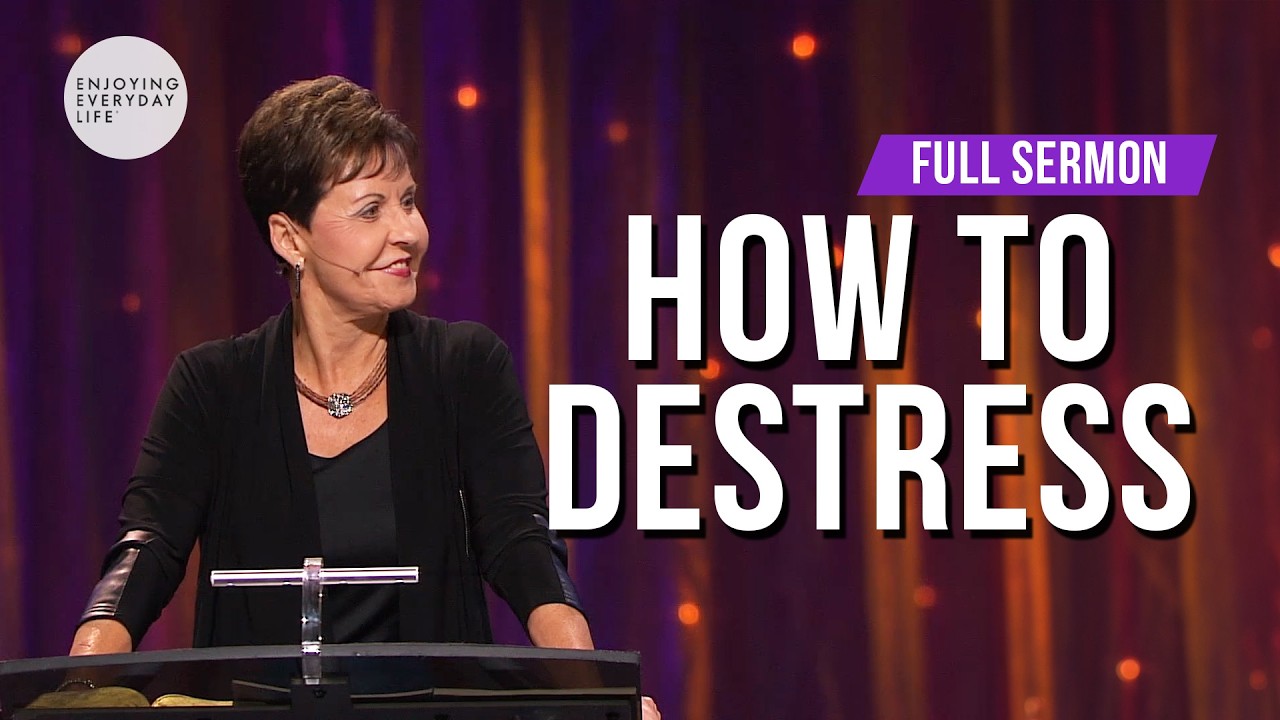
Video Summary
Meyer begins with Jesus’ promise of peace: “Peace I leave with you, My peace I give to you.” If someone has received Christ, she says, they have received the Prince of Peace, and peace lives within them. She compares this to a body of water in a storm: the surface may be choppy, but deep down it remains calm. Peace, she explains, is a quiet heart that can remain steady regardless of circumstances.
She admits peace has not come easily to her. While her husband, Dave, has always found it easy to cast his cares on God, she spent years “hanging by her fingernails.” Yet she says she is more peaceful now than ever, despite carrying more responsibility. If she can learn peace, she tells her audience, so can they. She then teaches from Matthew 11, addresses guilt and condemnation from Psalm 32, and outlines four ways Jesus managed stress: trusting God, praying, knowing when to be quiet and forgiving quickly.
Key Takeaways
- Believers already have peace because Christ, the Prince of Peace, lives in them.
- Peace is a quiet heart that can remain steady in stormy circumstances.
- Jesus invites us not only to come to Him but to learn His ways.
- God often wants to change us more than He wants to change our circumstances.
- Living under guilt and condemnation is one of the greatest sources of stress.
- Jesus trusted God, prayed, knew when to stay silent and forgave quickly.
- Real stress is not just what is happening around us but what is happening in us.
Come to Me and Learn of Me
Meyer’s central text is Matthew 11:28-30: “Come to Me, all you who labor and are heavy laden, and I will give you rest. Take My yoke upon you and learn from Me.” She notes that people love verse 28 but often skip verse 29. Jesus does not simply promise to remove stress; He invites us to learn how He lives.
Explaining the image of a yoke, she describes two oxen joined together so they can share a load. When we stay “yoked” to Jesus, He pulls with us, making the burden lighter. It also means staying close enough to watch how He handles each situation and then following His example.
She encourages believers to pray, “God, teach me Your ways.” While Israel saw God’s acts, she notes, God made His ways known to Moses (Psalm 103:7). Many people want miracles that remove pressure, but Meyer urges listeners to go deeper and ask God to show them how to handle situations as He would.
God Wants to Change You
Meyer recalls years spent trying to change her husband, her children and her circumstances. None of it worked. Her conclusion is direct: God does not want to rearrange everything around us so life is always comfortable; He wants to change us. Following Jesus means learning to respond as He would.
Freedom From Guilt and Condemnation
Meyer says God placed an additional word on her heart during worship. Many people, she believes, live with a constant sense of guilt, a feeling that something is always wrong with them or that God is displeased. She shares that she grew up feeling guilty because of the abuse she experienced from her father, and even after confessing sin she still felt condemned.
She compares herself to her mother’s old pressure cooker: sealed tight, with steam building inside until the slightest touch caused an explosion. Much of her stress, she realized, came from inside, not from her circumstances.
Turning to Psalm 32:1-5, she highlights David’s words: “I acknowledged my sin to You… and You forgave the iniquity of my sin.” Meyer emphasizes that God forgives not just the sin but the guilt. If God has removed our sin, she asks, what is left to feel guilty about? She encourages believers to put on the robe of righteousness and stop treating self-hatred as a form of spirituality, reminding them that they cannot escape themselves, so they must learn to receive God’s love and accept themselves in Christ. For more on this, see her message Truth About Identity – Pt 1.
Four Ways Jesus Handled Stress
1. He trusted Himself and everything to God. Meyer quotes 1 Peter 2:23, which says that when Jesus was reviled, He did not retaliate but committed Himself to Him who judges righteously. She keeps this verse on her office wall and says trust is the answer to all frustration.
2. He prayed. Jesus often withdrew to pray, sometimes rising early or praying all night. In Gethsemane, deeply grieved, He prayed, and an angel came to strengthen Him. Meyer notes that prayer does not always remove what troubles us; often God strengthens us to endure it with a good attitude.
3. He knew when to be quiet. In John 14:30, Jesus told His disciples He would not say much more because the ruler of this world was coming. Isaiah 53 says He was led like a lamb to the slaughter and did not open His mouth. Before His accusers, He made no reply. Meyer notes that during His hours on the cross, the recorded words of Jesus take only about a minute to speak. She admits it is hard not to defend ourselves, but often speaking makes matters worse.
4. He forgave quickly. On the cross, Jesus prayed, “Father, forgive them, for they do not know what they do.” Meyer warns that being easily offended is a recipe for a stressed and miserable life. If Jesus could forgive His executioners, believers can let go of everyday offenses. For further teaching, see Battlefield Of The Mind.
Frequently Asked Questions
What does Joyce Meyer say causes stress?
She teaches that much of our stress comes from what is happening inside us, such as guilt, offense, worry and our words, rather than only from our circumstances.
What does it mean to take Jesus’ yoke?
According to Meyer, it means staying closely connected to Jesus so He shares our burdens, and learning to live and respond the way He does.
How did Jesus handle stress?
Meyer points to four practices: He trusted God with everything, prayed regularly, knew when to remain silent and forgave quickly.
Final Thoughts
How To Destress is a practical and honest message from Joyce Meyer, who speaks as someone who once lived in constant turmoil and learned to walk in peace. Her message is hopeful: peace can be learned. By receiving God’s forgiveness, staying yoked to Jesus and following His example of trust, prayer, restraint and forgiveness, believers can experience a quiet heart even in a stressful world.
