Laws and Principles For Success In Life | Dr. Myles Munroe | MunroeGlobal.com
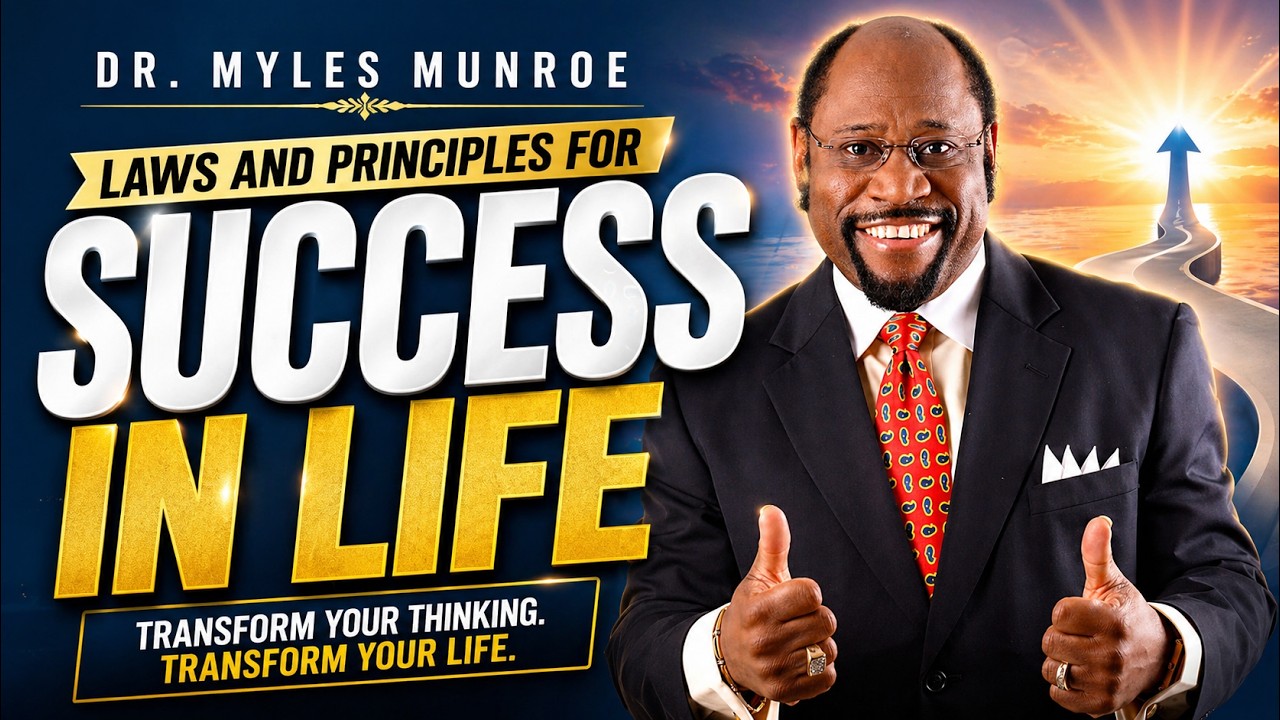
Delivered at the start of 2010, a year he described as marked by global uncertainty, this teaching by Dr. Myles Munroe explains why the world so often feels chaotic and what God’s answer to chaos has always been. Drawing his framework from the opening verses of Genesis, Munroe argues that the laws and principles for success are not mysterious: order, purpose and obedience to God’s law produce life, while ignorance and disorder produce confusion and self-destruction.
Video Summary
Munroe opens by describing the mood of the time: economic crisis, fears of terrorism, tighter airport security and leaders in government, business and church who seemed unsure what to do. Forecasts were gloomy, and many people lived without any sense of certainty. Yet he offers encouragement: chaos is as old as Genesis, and the Bible both diagnoses it and prescribes its cure.
He turns to Genesis 1:2, which describes the earth as “without form, and void; and darkness was on the face of the deep.” Munroe explains how he understands each term. “Without form” means out of order. “Void” means confused. “Darkness,” in his reading, refers not merely to a lack of physical light but to ignorance of purpose. When purpose is unknown, things fall out of order; when things are out of order, confusion and misuse follow.
Key Takeaways
- Chaos is not new; Genesis 1:2 describes it and Genesis 1:3 shows God’s response.
- Munroe defines darkness as ignorance of purpose and disorder as wrong relationships.
- Disorder often means everything is present but in the wrong place.
- God’s first response to chaos was “Let there be light,” which Munroe interprets as restoring knowledge of purpose.
- Confusion is often solved by information and understanding, not merely by more activity.
- Every stable nation, company or family is built on law, and God’s laws carry built-in consequences and benefits.
Disorder: Everything Present, Nothing in Place
One of Munroe’s most memorable illustrations involves a house. If someone moved everything from the kitchen into the bathroom, nothing would be missing from the house, yet nothing would work properly. Disorder, he explains, does not necessarily mean something is absent. It means things are located in the wrong place and therefore relating to the wrong things. Chaos, in this sense, can be a sign that all the resources are present but misplaced.
He applies this principle widely: social, economic, political, educational and judicial problems, crime, abuse and religious conflict. In his view, many of these troubles arise because people have become confused about the purpose and proper place of things.
Let There Be Light
The remedy, Munroe says, appears in the very next verse. First, the Spirit of God moved over the waters, showing that God’s presence is the first need in chaos. Then God said, “Let there be light.” Munroe points out that the sun is not created until verse 14, so he concludes that the light of verse 3 refers to God restoring knowledge, revealing where everything belongs and why it exists. He adds that from verse 3 onward God largely separates and arranges what is already there, bringing order out of confusion.
His practical application is direct: when nothing seems to work in a home, business, marriage or community, people often need understanding before anything else. “When you are confused,” he says, “you need information.” In his teaching, prayer and knowledge are meant to work together, and disorder is corrected by restoring order.
Clarity as Clear as Night and Day
God separated the light from the darkness and called them day and night. Munroe sees in this a principle of clear distinction. He contends that many modern problems stem from “living in the gray,” where right and wrong are treated as relative and truth is defined by personal preference. He gives everyday examples, such as rationalizing small dishonesty at work, and applies the same principle to sexual ethics and other moral questions, arguing for clear biblical standards. These are Munroe’s convictions as a pastor, presented in his characteristically blunt and humorous style.
The Kingdom Is Built on Law
Munroe’s broader framework is the kingdom of God. Jesus, he emphasizes, did not come to establish a religion but to bring a kingdom, and a kingdom is like a country. Every stable country is founded on a constitution and the rule of law, not on the whims of rulers. In the same way, God’s first gift to Adam was law: freedom to eat from every tree, with one clear boundary and a warning that disobedience would bring death.
Munroe stresses that God did not “kill” Adam; Adam activated death by breaking the law. God’s laws, he explains, have their consequences built in. Violating them leads to self-destruction, while keeping them brings blessing. He notes that when God formed a nation from a people just freed from slavery, the first thing He gave Moses was law, the Ten Commandments, with instructions to teach them diligently to every generation (Deuteronomy 6:6–9). Law, in Munroe’s teaching, remains the foundation of any nation, company or family. For more of his kingdom teaching, read Finding The Kingdom Of God Part 1 and The Discipline Of Vision.
Frequently Asked Questions
What does Myles Munroe say causes chaos?
Based on Genesis 1:2, he teaches that chaos results from disorder, confusion and darkness, which he defines as ignorance of purpose.
How does Munroe interpret “Let there be light” in Genesis 1:3?
Because the sun is created in verse 14, Munroe interprets the light of verse 3 as God restoring knowledge and purpose to a disordered world.
Why does Munroe emphasize law for success?
He teaches that all stable nations and kingdoms are built on law, and that God’s laws contain built-in consequences for violation and benefits for obedience.
Final Thoughts
“Laws and Principles For Success In Life” reflects Dr. Myles Munroe’s lifelong emphasis on purpose, order and the kingdom of God. His message is that success is not luck and chaos is not destiny. When people discover God’s purpose, put things back in their proper place and live by His principles, order begins to replace confusion, whether in a heart, a home or a nation.
