The Puritan Prophecy Of Warning To America | Thanksgiving | Jonathan Cahn Sermon
In The Puritan Prophecy of Warning to America, a Thanksgiving message, Jonathan Cahn goes back to the voyage of the Puritans in 1630 and the words their leader, John Winthrop, spoke before they reached the New World. Cahn argues that Winthrop’s charge, modeled on the closing words of Moses in Deuteronomy, contained both a promise of blessing and a warning, and that both have played out in American history.
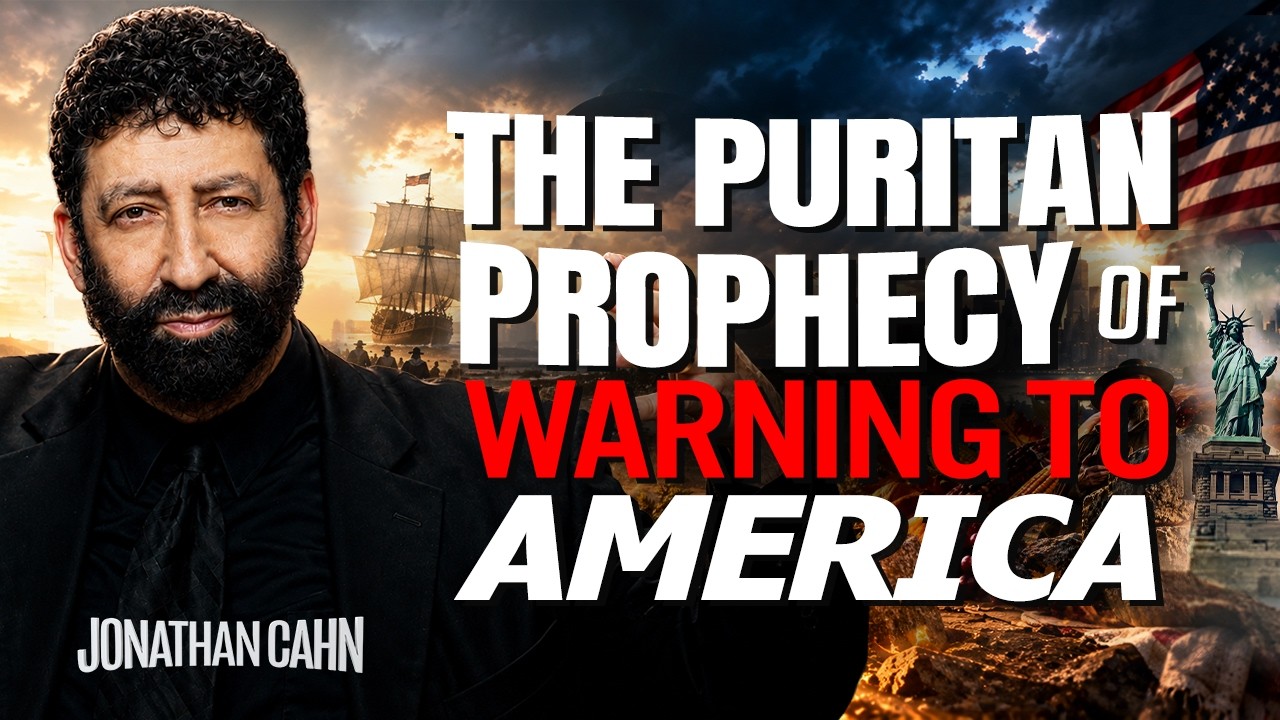
Video Summary
Cahn opens by describing America and ancient Israel as two civilizations that, in his view, were founded expressly for the purposes of God. He is careful to say that God did not make a covenant with America the way He did with Israel, but that the people who founded the colonies made a covenant with God, writing their faith into charters and constitutions.
At the center of the message is John Winthrop, whom Cahn calls the “Moses” of the Puritan exodus. Aboard the ship Arbella, Winthrop prepared a sermon known as A Model of Christian Charity, describing a community that would be “a city on a hill.” Cahn sets Winthrop’s words side by side with Deuteronomy 28 and shows how closely they echo the blessings Moses promised Israel: the Lord commanding a blessing on everything the people put their hands to, victory over enemies, and a name that other nations would notice.
From there Cahn traces what he sees as the fulfillment of those blessings, as America rose from a few struggling colonies to the most prosperous and powerful nation on earth, followed by what he describes as the curses of Deuteronomy appearing as the nation moved away from God.
Key Takeaways
- Winthrop’s 1630 sermon borrowed the language and structure of Moses’ charge in Deuteronomy 28.
- Cahn sees America’s rise to prosperity and power as the blessing side of that pattern.
- He links a turning away from God since the 1960s to signs he associates with the warnings of Deuteronomy 28.
- He points to the loss of hope, community, moral clarity and purpose as fruits of removing God from public life.
- His conclusion: for America, revival is not optional but a matter of survival.
The Blessings and the Warnings of Deuteronomy 28
Cahn reads extensively from Deuteronomy 28, where blessing follows obedience and loss follows departure. He highlights specific parallels. Moses said an obedient nation would lend to many and borrow from none; Cahn notes that America was once the world’s greatest creditor nation and has since become its greatest debtor. Moses spoke of enemies fleeing seven ways; Cahn connects the nation’s first lost war in the Vietnam era to the reversal of that promise. He presents these as patterns that should cause believers to take the old warning seriously.
Boston, Winthrop’s Island and September 11
One of the most striking parts of the message concerns September 11, 2001. Cahn notes that the Torah portion read in synagogues around the world in the week before the attacks was Deuteronomy 28, the same passage that framed Winthrop’s charge. He then observes that Winthrop founded Boston, that the first hijacked planes departed from Boston’s Logan International Airport, and that the airport was built on land that once included the island where Winthrop lived. For Cahn, this convergence is a sign worth pondering, connected to the themes he explored in The Harbinger.
What Was Lost When God Was Removed
Cahn lists several things he believes the Puritans possessed and modern culture has lost:
- Hope. He cites rising rates of depression, self-harm and suicidal thoughts among young people and ties them to a generation raised furthest from faith. “Without God, no hope,” he says, while reminding listeners that even God’s discipline is a sign of a loving Father.
- Community. He describes neighborhoods that feel empty and studies showing fewer close friendships, and encourages believers not to neglect gathering together, as Hebrews 10:25 urges.
- Moral clarity. He challenges the idea of “personal truth,” arguing that truth is objective, and compares today’s confusion to the days of the Judges when “everyone did what was right in his own eyes” (Judges 21:25).
- Purpose. He says a sense of mission once defined the nation and that its loss is felt most among the young.
Cahn also discusses the Puritans’ love for Israel, noting that they studied Hebrew and modeled their society on biblical Israel, and that even Thanksgiving echoed the Feast of Tabernacles. He expresses concern about any American turn away from Israel and urges prayer.
Revival Is Survival
The message ends with a call to personal and national revival, grounded in 2 Chronicles 7:14: “If My people who are called by My name will humble themselves, and pray and seek My face, and turn from their wicked ways…” Cahn argues that political change can slow decline but cannot reverse it; only a return to God can. He asks listeners to remove from their lives what should not be there, add what should, pray daily for revival, and become the kind of person described in 2 Chronicles 16:9, whose heart is fully devoted to the Lord. He closes with Jesus’ words in Matthew 5:14-16: “You are the light of the world. A city that is set on a hill cannot be hidden.”
For more on these themes, see Cahn’s teaching on the template of national judgment and his message on the Joshua and Caleb key to victory.
Frequently Asked Questions
Who was John Winthrop?
John Winthrop led the Puritan migration to Massachusetts in 1630, became governor of the Massachusetts Bay Colony and helped found Boston. His sermon A Model of Christian Charity introduced the image of America as “a city upon a hill.”
Why does Jonathan Cahn connect Deuteronomy 28 to America?
Cahn notes that Winthrop modeled his charge on Moses’ words in Deuteronomy 28. He sees that chapter as a template of blessing for obedience and warning for departure, and believes America’s history reflects both sides of it.
What does Cahn mean by “revival is survival”?
He means that, in his view, America has moved so far from its spiritual foundations that only a genuine turning back to God, beginning with individual believers, can restore the nation.
Final Thoughts
This Thanksgiving message invites viewers to remember the faith that shaped America’s beginnings and to weigh the warning that came with it. Whatever one concludes about the parallels Cahn draws, his closing challenge is personal and practical: choose revival in your own life, pray for your nation, and let your light shine as a city on a hill.
