Knowing — A Conversation with Bishop T.D. Jakes featuring Touré Roberts
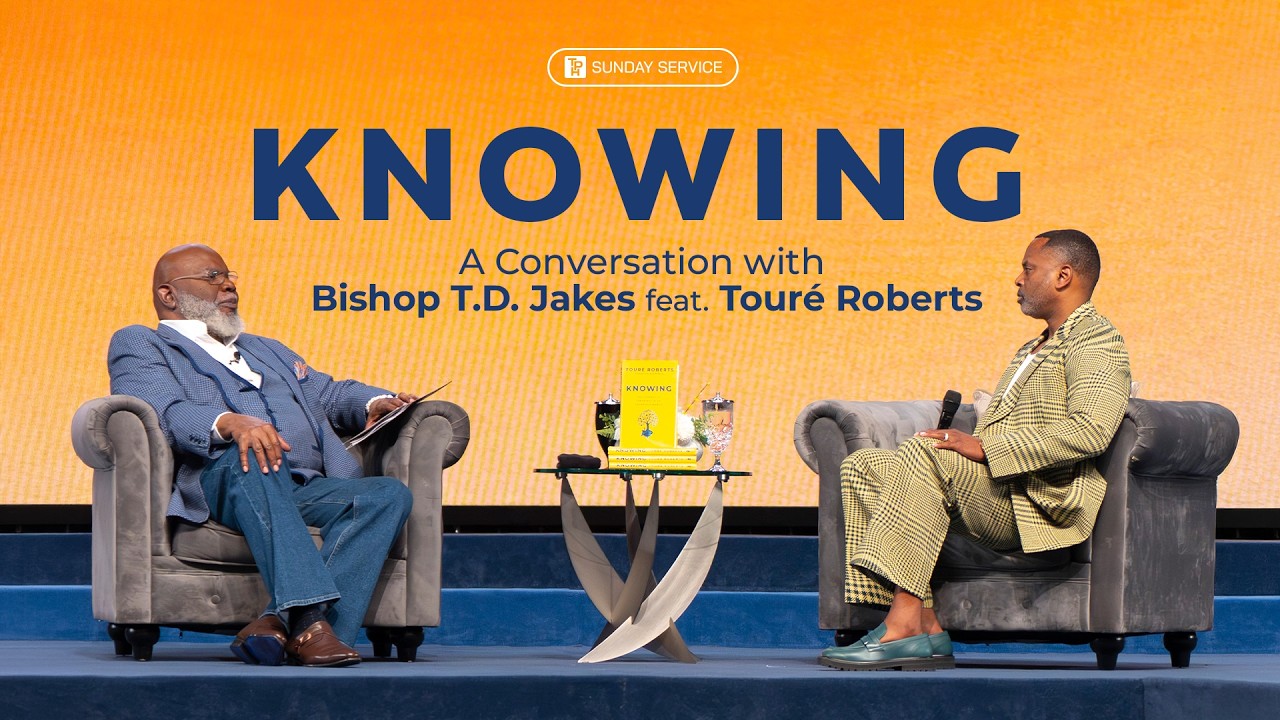
In Knowing — A Conversation with Bishop T.D. Jakes featuring Touré Roberts, Bishop Jakes sits down with his son-in-law, Pastor Touré Roberts, to discuss Roberts’ book on “knowing” and the journey to certainty in an uncertain world. What makes the conversation especially moving is its timing: it took place shortly after a serious family emergency, giving both men an opportunity to speak honestly about faith, pain, humility and what it means to know God in the middle of a storm.
Video Summary
Jakes opens by noting that talking with an author is a little like the difference between knowing the Bible and knowing God: you discover not only what was written, but what shaped the person who wrote it. He then shares that the family had recently been shaken by an unexpected event. According to Jakes, Pastor Sarah Jakes Roberts had been injured in a trampoline accident and suffered a serious neck injury, leading to hours of uncertainty in hospitals. The family remained by her side while Roberts continued to minister on the very subject of his new book.
From there, the conversation explores how difficult seasons reveal our “raw materials,” why the anointing is forged through trials, how knowing God is a progressive journey rather than a final destination, and how believers can live in the tension between faith and uncertainty. Both men speak candidly, offering pastoral wisdom drawn from Scripture and lived experience.
Key Takeaways
- Life often requires believers to practice what they teach precisely when circumstances seem to contradict it.
- Being honest about pain can deepen relationships rather than weaken leadership.
- Difficult seasons function like a cocoon in which God develops character.
- What we feed ourselves in peaceful times is what comes out of us in storms.
- Knowing God is progressive and requires humility; no one ever fully arrives.
- Mature faith learns to live in tension and to cast down imaginations that magnify fear.
The Trying of Your Faith
Jakes reflects on the strange timing of Roberts’ book release. Just as Roberts was preparing to teach about knowing, the family faced a crisis they did not see coming. Jakes calls this “the trying of your faith,” a phrase from James 1:2-4. With characteristic humor, he lists examples of life’s contradictions: preaching on healing and then falling ill, counseling couples and then arguing at home, or teaching children and then discovering one’s own child in trouble.
He also observes that this was the first time the congregation had walked through a storm alongside Roberts as their pastor. In Jakes’ experience, people often connect most deeply with leaders not through performance, but through seeing how they weather hardship. It took him fifty years to learn that, he jokes, and he was passing it on in five.
“I’m Not Okay, but I Am Kept”
When Jakes asks Roberts how he is doing, Roberts answers as a son rather than as a public figure. He says he loves his wife deeply and cannot be okay when she is not. Yet he describes himself as “kept,” referencing 1 Peter 1:5, which speaks of believers being kept by the power of God through faith. He is grateful that God preserved her life and believes God would not have allowed the family to face this trial without first preparing them to stand through it.
Jakes responds by affirming the value of a family that stands together. He says everyone needs a safe place to be human without criticism. Prayer and God’s presence are essential, but people also need human touch, which is part of why God became flesh. In Jakes’ view, ministering while carrying pain, crying on the way to church and on the way home, is part of what makes someone truly the Lord’s servant. He adds that sheep often come to know their shepherd best in moments of weakness, echoing 2 Corinthians 12:9, “My strength is made perfect in weakness.”
Hard Seasons Reveal Our Raw Materials
Roberts explains that the first chapter of his book is titled “Be Still and Know.” He describes certain life seasons as cocoons in which God develops a person. It would be easier, he admits, if God shaped us in a comfortable classroom where we could simply observe others, but in God’s process, we are the subject. Learning to trust God’s heart when we cannot see His hand produces fortitude. A trial, he says, will either break a person or make them, and he has chosen to let it make him.
Jakes adds that this is why believers should read the Word and helpful books even when they think they do not need them. Whatever a person has fed themselves, he says, is all they will have to draw from in the storm, whether that is faith or fear, peace or anger. He contrasts borrowed words with genuine anointing, suggesting that the deepest anointing comes through trials rather than celebrations. This idea connects with his earlier message God Is Preparing You for Greatness.
Knowing Is a Journey, Not a Graduation
Jakes highlights the book’s subtitle, “The Journey to Certainty in an Uncertain World,” and notes that believers often look for a moment of graduation that never comes. Instead, life moves to new levels of testing and new levels of knowing. He compares it to marriage: a couple knows each other when they marry, but they come to know each other more deeply through every season, including illness and hospital rooms. He likens God’s self-revelation to an unveiling, drawing on the meaning of the Greek word behind “Revelation.” God is the same in the fire as in the desert, but His people discover His faithfulness in each new setting.
Roberts describes a chapter called “The Catalyst of Ignorance.” Science, he notes, invests in exploring what it does not yet know. Likewise, true knowing begins with humility. Quoting 1 Corinthians 2:9-10, he explains that God reveals things by His Spirit, yet there is always a gap between what God knows and what we currently understand. The more he learns, Roberts says, the more he realizes how much he does not know, until the day believers “know as they are known.”
Living in the Tension
Jakes seizes on Roberts’ use of the word “tension.” Many people, he says, expect to start living once the tension ends, but tension may never fully disappear. He notes that the Greek word often translated “knowing” carries a sense of progressive knowledge: believers grow in their knowledge of Christ, of themselves, of their children and of their relationships.
He then shares how his imagination ran ahead of reality after hearing about the accident. Because he tends to think in pictures, he envisioned something far worse than what he saw when he arrived. He connects this to Paul’s instruction about casting down imaginations that exalt themselves against the knowledge of God (2 Corinthians 10:5). Believers, he says, must reject visions of catastrophe and seek a vision of overcoming, recognizing that there are always competing voices, one saying “you won’t make it” and another declaring “I can do all things through Christ.”
Frequently Asked Questions
What is the book “Knowing” about?
According to the conversation, Touré Roberts’ book explores the journey to certainty in an uncertain world, emphasizing humility, spiritual growth and coming to know God more deeply through every season.
What does T.D. Jakes say about suffering and ministry?
Jakes says that ministering while carrying personal pain is part of what makes someone a true servant of God, and that people often connect most deeply with leaders who are honest about their struggles.
What does it mean to “live in the tension”?
Both men describe faith as learning to trust God while uncertainty remains, rather than waiting for every difficulty to disappear before living fully.
Final Thoughts
This conversation between Bishop T.D. Jakes and Touré Roberts is honest, tender and full of practical wisdom. Rather than offering easy answers, it models what it looks like to keep trusting God while the outcome is still uncertain. For anyone walking through a storm, the message is clear: knowing God is a lifelong journey, hard seasons can shape us, and we can be “kept” by God’s power even when we are not okay.
