God’s Trying To Get Your Attention | Steven Furtick
In the sermon God’s Trying To Get Your Attention, Pastor Steven Furtick explores the pivotal moments when the Lord speaks with unusual persistence. Drawing on the Last Supper and Jesus’ words “Simon, Simon,” Furtick walks through every instance in Scripture where God calls a person’s name twice, and argues that repeated patterns in a believer’s life are often God’s way of saying: pay attention, this is a turning point.
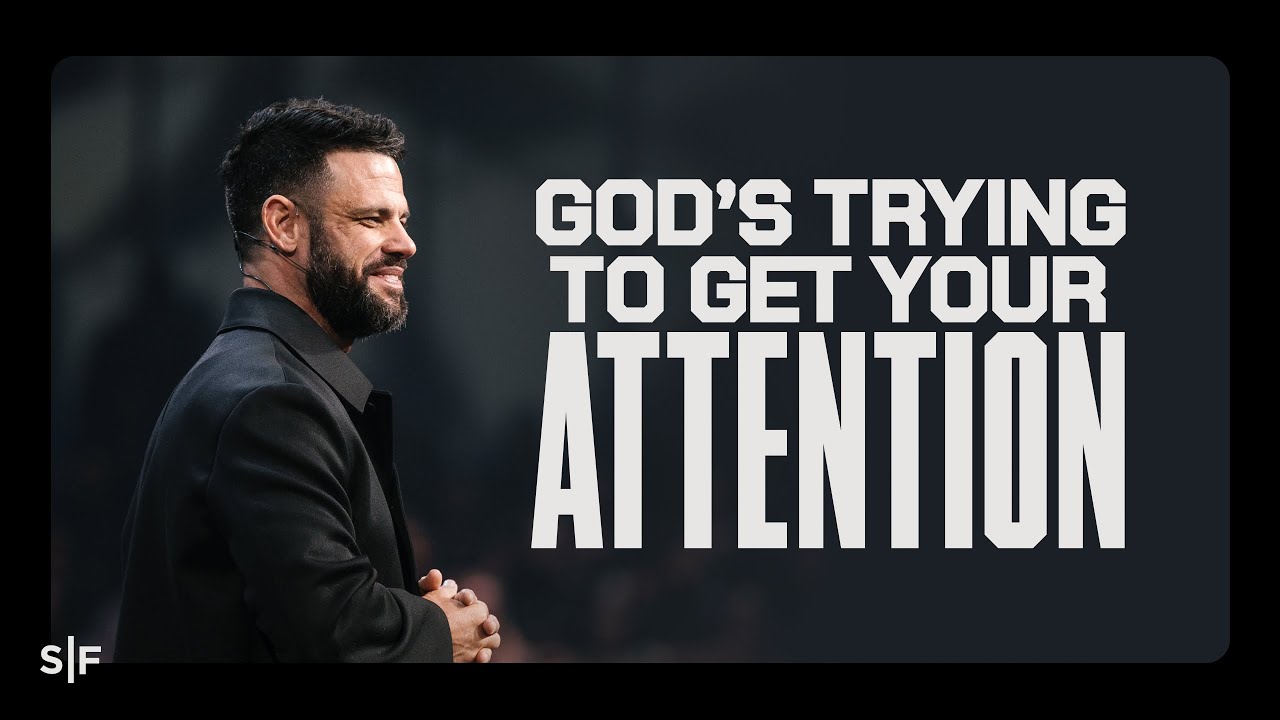
Video Summary
Furtick begins with a simple physical illustration. Standing on stage, he pivots on his back foot, a movement so small that the audience barely notices. Yet he explains that if he kept walking in the new direction, every additional step would magnify the importance of that tiny pivot, eventually bringing him to an entirely different destination. Pivotal moments, he says, are rarely big, but they make all the difference.
He then shares a conversation with his oldest son, Elijah, about a social media personality who made a dramatic, very public commitment to Christ, spent about two years declaring how much holier they were than others, and then publicly renounced the faith. Furtick’s advice to his son was to watch out for big swings, because whatever swings far in one direction usually swings back. His summary phrase, “think steps, not swings,” becomes a thread running through the whole message.
From there Furtick turns to the Last Supper in Luke 22. He describes the table as a place where joy and grief sat side by side: supper and suffering, Jesus and Judas, the bread and its breaking. Into that setting Jesus speaks to Peter with the words “Simon, Simon,” a double call that Furtick connects to a series of other moments in Scripture when God called someone’s name twice. Each, he says, marked a pivotal moment in that person’s story.
Key Takeaways
- Small pivots, multiplied over many steps, determine where a life ends up.
- Think steps, not swings: sustainable faith grows through consistent obedience rather than extreme overcorrections.
- Happiness and heaviness often sit at the same table, and mature faith learns to carry both.
- When God calls a name once it is personal; when He calls it twice it is pivotal.
- God often repeats the same message through different means to get a person’s attention.
- Prayer is not just listing requests; it is also listening to what God is saying.
Think Steps, Not Swings
Furtick is careful not to dismiss dramatic spiritual decisions. He acknowledges that there are holy moments when people declare they are leaving their “Egypt,” burning bridges to old compromises and stepping into faith with their whole heart. Those moments matter. However, he warns about extreme swings that are more about self-image than transformation.
With humor, he imagines someone who claims God told them never to wear pink again because purple is the color of royalty, who plans to pray at 2 a.m., exercise at 3 a.m. and take communion at 4 a.m., but never from a plastic cup. The exaggeration makes a serious point: whether in diet or discipleship, intense overcorrections often fail to last. According to Furtick, a faithful step taken consistently is better than a spectacular swing that eventually swings back. His observation about the former influencer is also pastoral: one person walking away from the faith does not invalidate the faith of those who remain.
Happiness and Heaviness at the Same Table
The emotional heart of the sermon is Furtick’s reflection on the Last Supper. Jesus told His disciples He had eagerly desired to eat that Passover with them, and they reclined together like family. Viewed out of context, Furtick says, the scene might look like a joyful meal. Yet Jesus knew He was about to suffer, Judas was about to betray Him, and the disciples were about to face the most painful days of their lives.
Furtick notes that Jesus was ready for that moment, because He is the Lamb of God, but the disciples were not. From this he draws a principle for every believer: the happiest moments and the heaviest moments often happen at the same time. Life is not neatly divided into happy seasons and hard seasons. Many people sit at tables surrounded by things they love while carrying things they must endure.
He compares this to buying shoes: a store will not sell only the right shoe at half price, because shoes come in pairs. In the same way, a calling includes both joy and weight. Feeling down in the middle of a good moment does not mean a person is ungrateful; according to Furtick, it often simply means they are grown up and carrying responsibility. Prayer, he says, keeps the happiness from hiding behind the heaviness, because it reminds believers that Jesus is present in both. This idea pairs well with his message God’s Asking You To Trust Him, which also focuses on faith in uncertain seasons.
When God Calls Your Name Twice
Turning to Jesus’ words to Peter in Luke 22:31-32, “Simon, Simon! Indeed, Satan has asked for you,” Furtick leads his congregation and online audience through a Bible quiz on the other times a name is called twice in Scripture.
- Saul, Saul: On the road to Damascus, Jesus stopped a persecutor of Christians and turned him into the apostle Paul, a pivot that carried the gospel to the Gentiles.
- Moses, Moses: At the burning bush, God told Moses to remove his sandals because he was standing on holy ground, marking the start of his calling.
- Samuel, Samuel: As a boy, Samuel mistook God’s voice for Eli’s, so God called again. Furtick notes that many people have heard God calling since childhood and have spent years running from that call.
- Martha, Martha: In Luke 10, Jesus gently corrected a distracted Martha, showing that He cared more about her as a person than about her plans and productivity.
- Abraham, Abraham: At the moment Abraham raised the knife over Isaac, God stopped him and provided a ram, revealing that the test was about trust.
Furtick also mentions Jesus’ cry from the cross, “My God, My God,” as a related example. His summary line is memorable: when God calls a name once, it is personal; when He calls it twice, it is pivotal. A single call may be powerful, but a repeated call reveals a pattern. Furtick believes many people are hearing God repeat the same message in different ways, and that this repetition is an invitation to stop and respond.
Prayer Is Listening, Not Just Listing
Near the end, Furtick challenges a common approach to prayer. He admits he was taught to pray from a list, giving God a checklist of what He should do and by when. While bringing requests to God is biblical, he insists that prayer is also listening. Sometimes what God says is difficult to hear, especially when He asks a person to surrender something they love rather than something they already wanted to lose.
The story of Abraham illustrates this well. God’s call was costly, yet the pause at the critical moment led to provision. Furtick encourages listeners to treat repeated nudges, persistent convictions and recurring Scriptures as possible signs that God is calling their name a second time. As John 10:27 says, “My sheep hear My voice, and I know them, and they follow Me.” For more on responding to God in hard moments, readers may also appreciate Trust That God’s Working It Out.
Frequently Asked Questions
What is “God’s Trying To Get Your Attention” about?
It is a sermon by Steven Furtick about pivotal moments, the tension of joy and sorrow in the Christian life, and the biblical pattern of God calling a person’s name twice to get their attention.
Who in the Bible had their name called twice by God?
Furtick highlights Abraham, Moses, Samuel, Martha, Simon Peter and Saul, as well as Jesus’ cry “My God, My God” on the cross.
What does Furtick mean by “think steps, not swings”?
He means that lasting spiritual growth usually comes through steady, consistent obedience rather than extreme, short-lived overcorrections that tend to swing back.
Final Thoughts
Steven Furtick’s message is both encouraging and searching. It reassures believers that carrying heaviness does not cancel their happiness, and that Jesus sits with them at every table. At the same time, it invites honest reflection: what message has God been repeating lately? According to Furtick, a pivotal moment rarely looks dramatic, but a small pivot toward God’s voice, followed by faithful steps, can lead to an entirely different destination.