Walking with God Through the Dark Times – Dr. Charles Stanley
Every believer eventually faces seasons that feel like midnight: a marriage falling apart, a lost job, a prolonged illness, a wayward child, or dreams that have collapsed. In this sermon, Dr. Charles Stanley offers a biblical roadmap for walking with God through the dark times. Using the life of Joseph in Genesis 37–50 as his case study, he lays out principles that help Christians respond with faith rather than despair when they cannot see what God is doing.
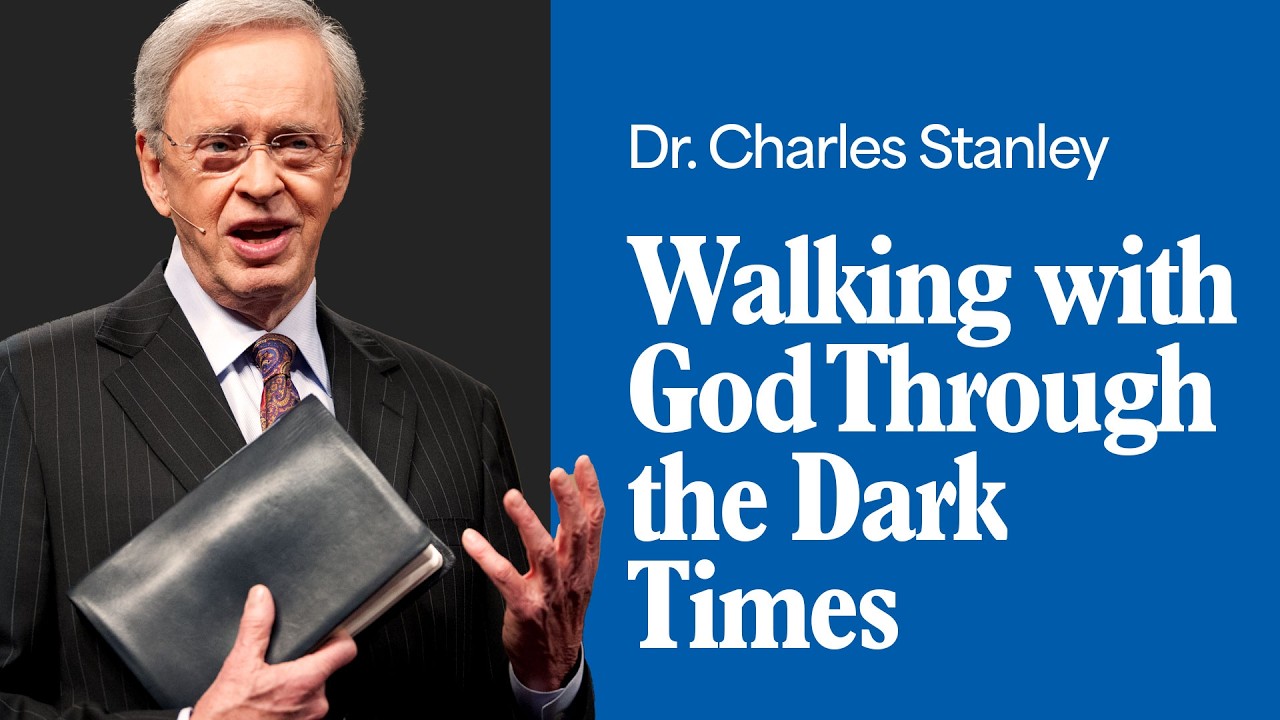
Video Summary
Stanley begins by acknowledging that dark times are universal. Some are brief and some drag on for years, and often believers cannot understand why God does not simply end them. He then draws an important distinction. Scripture says God has rescued believers from the domain of darkness and transferred them into the kingdom of His Son (Colossians 1:13). Christians therefore do not walk in darkness in the sense of living in sin, as 1 John 1 describes, but they do walk through dark seasons of hardship and pain.
Why does the Bible include so many detailed accounts like Joseph’s? According to Stanley, they are not mere stories but real events recorded so that later generations can see how God worked and discover principles that still apply. Joseph’s circumstances will not be repeated exactly in anyone’s life, he says, but the principles that carried Joseph through thirteen years of hardship will be needed by everyone.
He then retells Joseph’s journey: the favored son with the multicolored coat, the dreams that angered his brothers, the plot to kill him that turned into a sale to a caravan, his rise in Potiphar’s household, the false accusation by Potiphar’s wife, years in prison, the forgotten promise of the butler, and finally his elevation to prime minister of Egypt, where he preserved both his family and an entire civilization during seven years of famine.
Key Takeaways
- Believers are not living in the darkness of sin, but they will walk through dark seasons of difficulty.
- God is present with His children in every dark time, just as “the LORD was with Joseph.”
- God always has a purpose for allowing darkness, even when that purpose is hidden.
- A dark season lasts as long as necessary for God to accomplish His purpose.
- People often learn more in the dark than in the light, about God and about themselves.
- Even in the darkest valleys, a believer focused on God is still moving toward the light.
Principle One: God Is With Us in the Darkness
Stanley calls this the foundational principle. At every stage of Joseph’s ordeal, God was present. He moved Reuben and Judah to spare Joseph’s life. In Potiphar’s house, Genesis 39 repeatedly says that the Lord was with Joseph and made everything he did prosper, so that Potiphar entrusted him with everything he owned. Even after Joseph refused the advances of Potiphar’s wife and was thrown into prison, the same phrase appears again: the Lord was with Joseph and gave him favor with the chief jailer.
Stanley connects this to God’s promise in Hebrews 13:5 that He will never leave nor forsake His people, and to Psalm 139:7–12, which declares that even darkness is not dark to God and the night shines like the day. However, he is careful to add that this promise belongs to God’s children. For anyone who has rejected Christ, he says, the way into that relationship is the cross, where Jesus’ shed blood makes it possible for a sinner to be forgiven and indwelt by the living God.
Principle Two: God Has a Purpose
When believers cannot see any good in their circumstances, Stanley points them back to Romans 8:28: God causes all things to work together for good. In Joseph’s case, the purpose was preparation for an extraordinary place of service. What looked like pure evil on the part of his brothers became, in God’s hands, an act of salvation for his family and for Egypt.
Stanley imagines how often Joseph must have asked why he was enslaved, why his faithfulness was rewarded with prison, and why the butler forgot him for two more years. Thirteen years passed with no family nearby and no visible sign that God cared. That, Stanley says, is where real character is revealed: the willingness to trust God when nothing around a person seems to confirm His love.
Principle Three: It Lasts as Long as Necessary
Many Christians want to pray once, claim deliverance and move on, only to find that things get darker. Stanley explains that the length of a dark season is tied to God’s purpose. Joseph needed those years to learn Egypt’s language and customs, to become an administrator and organizer in Potiphar’s house and in the prison, to live under authority and to become the right kind of authority. All of it prepared him to govern a nation.
Speaking from his own life, Stanley admits that in difficult seasons he has asked God what He was doing and heard nothing but silence. Yet every time he emerged, he could look back and see the purpose. He would not choose to repeat those seasons, he says with a smile, but he is grateful for what he learned in each of them.
Principle Four: We Learn More in the Dark
According to Stanley, Joseph likely learned humility and a deeper appreciation for his family, perhaps recognizing how his favored status had fueled his brothers’ resentment. He learned how faithful God is, discovered administrative gifts he never would have found while being pampered at home, and learned the strength of his own moral convictions when he refused the greatest temptation of his life and walked away. Those lessons came in the darkness, not in comfort.
Principle Five: Always Moving Toward the Light
Finally, Stanley emphasizes that even in dark times a believer is moving toward the light. In the pit, in slavery, under false accusation and in prison, Joseph was still advancing toward God’s purpose. When a person’s focus remains on the Lord, Stanley says, God is always moving that person toward the light, even in the darkest moments. For more of Stanley’s teaching on trusting God in difficulty, see How to Lay Your Burden Down and God’s Precious Promises.
Frequently Asked Questions
What Bible character does Charles Stanley use to explain dark times?
He uses Joseph, whose story in Genesis 37–50 includes betrayal, slavery, false accusation and imprisonment before he became prime minister of Egypt.
Does God cause dark times in a believer’s life?
Stanley teaches that God allows dark seasons for a purpose and works through them for good, as Romans 8:28 promises, even when the cause is other people’s wrongdoing.
How long will a dark season last?
According to Stanley, it will last as long as necessary for God to accomplish His purpose, which is why rushing through it is not always possible or wise.
Final Thoughts
“Walking with God Through the Dark Times” offers both comfort and challenge. Dr. Charles Stanley assures believers that they never walk alone, that their pain is not wasted, and that the God who saw Joseph in the pit and the prison sees them too. The challenge is to keep trusting and responding rightly while the lights are low, confident that what God is building in the dark will one day be revealed in the light.