The Trinity & The Mathematics Of Infinity | Jonathan Cahn Sermon
How can God be one and yet Father, Son and Holy Spirit? The Trinity has puzzled theologians for centuries and is attacked by skeptics and cults alike. In this sermon, Jonathan Cahn takes an unexpected approach—the mathematics of infinity. Drawing on Hebrew words for eternity and infinity, he shows why finite logic can never contain an infinite God, and how the math of infinity offers a striking glimpse into the mystery of the triune God.
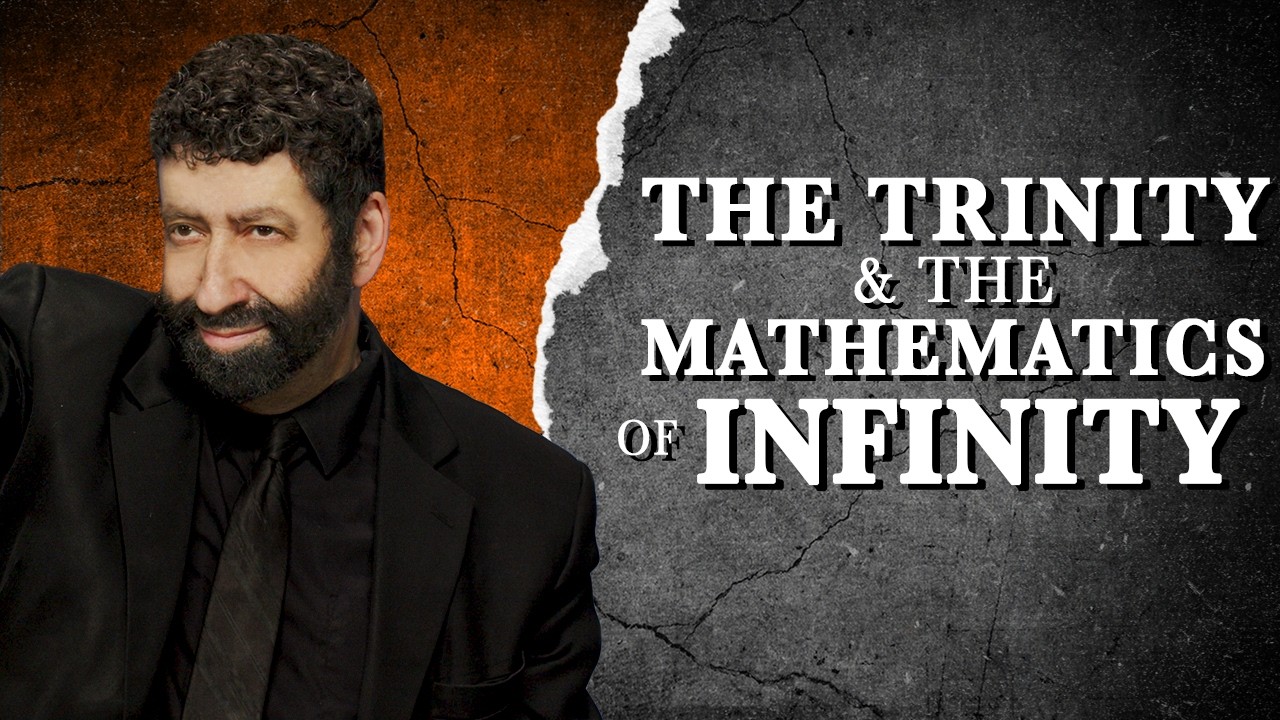
Video Summary: The Trinity & The Mathematics of Infinity
Cahn opens with a humorous story about sleeping through ninth-grade algebra—and never taking math again. But tonight, he says, we’re going to the “outer limits” of math. Scripture declares, “Hear, O Israel: The Lord our God, the Lord is one” (Deuteronomy 6:4), yet Messiah commands His disciples to baptize “in the name of the Father and of the Son and of the Holy Spirit” (Matthew 28:19). In ordinary math, 1 + 1 + 1 equals 3, never 1. Cahn explains why the problem lies not with the Trinity, but with trying to measure an infinite God by finite rules.
Key Takeaways
- The Trinity is in the Hebrew Scriptures from the very first verse—Elohim is a plural noun with a singular verb.
- The Shema mentions God three times: “The Lord, our God, the Lord is one.”
- Common analogies fall short: the egg divides God into thirds; water describes changing forms (modalism).
- Many cults reject the mystery instead of accepting a God bigger than human logic.
- Scripture reveals God as eternal and infinite—olam, kedem, and Ein Sof, “the One without end.”
- The key: you cannot describe the infinite with finite math.
- In the math of infinity, ∞ + ∞ + ∞ = ∞. Father, Son and Spirit—each infinite—are one God.
The Ancient Dilemma of the Trinity
The Bible clearly teaches one God. It also clearly speaks of Father, Son and Spirit. John writes, “The Word was with God, and the Word was God” (John 1:1). How can someone be with God and also be God? In our mathematics, one is not three and three is not one.
The Trinity Throughout the Hebrew Scriptures
The Trinity did not begin in the New Testament. The Bible opens, “In the beginning God (Elohim) created” (Genesis 1:1). Elohim is a plural noun, yet the verb bara (created) is singular—grammatically like saying “they creates.” From the first verse, God is revealed as both singular and plural. Likewise, the Shema could have simply said “the Lord is one,” but instead it names Him three times: “The Lord, our God, the Lord is one.”
Why Cults and Common Analogies Fail
Because the Trinity is a mystery, many groups try to eliminate it. Some say only Jesus is God; others say only the Father. Jehovah’s Witnesses teach that Jesus is a created being and translate John 1:1 as “the Word was a god”—which actually introduces more than one god. Modalism teaches that one God simply wears different “hats” at different times, like a small-town sheriff who is also judge and jailer, removing the real persons of Father and Son.
Even believers’ analogies can fall short. The egg (shell, white and yolk) describes an object with three parts—⅓ + ⅓ + ⅓ = 1—but God is not a third of God three times over. Water as ice, liquid and steam describes one substance changing forms, which is closer to modalism. As Cahn puts it, nothing in nature can fully contain that which is beyond nature. If human logic could fully comprehend God, it would be greater than God.
The Bible Reveals an Eternal and Infinite God
Kedem and Olam: The God of Eternity
“Are You not from everlasting, O Lord my God?” (Habakkuk 1:12). The word for everlasting, kedem, also means “east”—where the sun rises, a picture of eternity. Another word, olam, means the world, the universe, and forever, connected to the idea of a vanishing point beyond the horizon. God is called Melech HaOlam, King of the universe, and “His mercy endures forever” (le’olam).
Of the Messiah born in Bethlehem, Micah 5:2 says His “goings forth are from of old, from everlasting.” No angel or created being is from everlasting—only God. Isaiah 9:6 calls the child who is born “Everlasting Father,” the source of eternity itself.
Ein Sof: The One Without End
Isaiah 9:7 says of Messiah’s government, “there will be no end.” The Hebrew ein means “there is not,” and ketz/sof means “end” or “limit.” Jewish tradition calls God Ein Sof—He who is without end. “His greatness is unsearchable” (Psalm 145:3); “His understanding is infinite” (Psalm 147:5). Isaiah 57:15 calls Him “the High and Lofty One who inhabits eternity.” In time, God is eternal; in space and power, He is infinite. In Latin, finitum means ended; in-finitum means without end—infinite.
Solving the Mystery: The Mathematics of Infinity
Cahn identifies the core mistake in both attacks on the Trinity and weak explanations of it: they treat God as if He were finite. If you try to calculate something about ten people using the number eighteen, you will get the wrong answer. You must use the right figures. God is infinite, so we must use the language—and the math—of infinity.
In the finite realm, 1 + 1 + 1 = 3. One god plus one god plus one god would equal three gods—and that is not the Trinity. But in the realm of infinity, everything changes:
- Infinity + Infinity + Infinity = Infinity.
- The Father is infinite. The Son is infinite. The Holy Spirit is infinite.
- Together they are not three infinities, but one infinite God.
This does not mean we can fully comprehend God—”My thoughts are not your thoughts” (Isaiah 55:8-9). But it gives a powerful glimpse: what is impossible in finite terms is perfectly consistent in the realm of the infinite. The Trinity is not a contradiction; it is the nature of an infinite God.
For more of Jonathan Cahn’s teaching on the mysteries of God, read The Three Light Mystery and The Book of Revelation Temple Decoder.
Frequently Asked Questions
Is the Trinity in the Old Testament?
Yes. Jonathan Cahn points to Genesis 1:1, where the plural Elohim is used with a singular verb, and to the Shema in Deuteronomy 6:4, which names the Lord three times while declaring that He is one.
Does believing in the Trinity mean believing in three gods?
No. Biblical faith is monotheistic—there is one God in three persons: Father, Son and Holy Spirit. The Trinity is not three gods or three parts of God.
How does infinity explain the Trinity?
In finite math, 1 + 1 + 1 = 3. But God is infinite, and in the math of infinity, infinity + infinity + infinity = infinity. The Father, Son and Spirit, each fully infinite, are one God.
Why are the egg and water analogies inadequate?
The egg divides God into three parts, and the water analogy describes one substance in different forms at different times (modalism). Neither captures three distinct persons who are each fully God.
Final Thoughts
We will never fully comprehend God, and we don’t need to—He fully understands us. But the mathematics of infinity reminds us that the Trinity is not irrational; it is beyond the limits of finite thinking. Our God is Ein Sof, without end: Father, Son and Holy Spirit, one infinite God, whose mercy endures forever.
