The Mystery Of Islam | Jonathan Cahn Sermon
Why has the Middle East been at the center of so much conflict? In this sermon, Jonathan Cahn explores what he calls the mystery of Islam—not primarily as a theological debate, but through a biblical lens that goes all the way back to the tents of Abraham and the story of his two sons, Ishmael and Isaac. He then turns the message personally, showing how any believer can fall into “the spirit of Ishmael,” and how to walk instead as a child of promise.
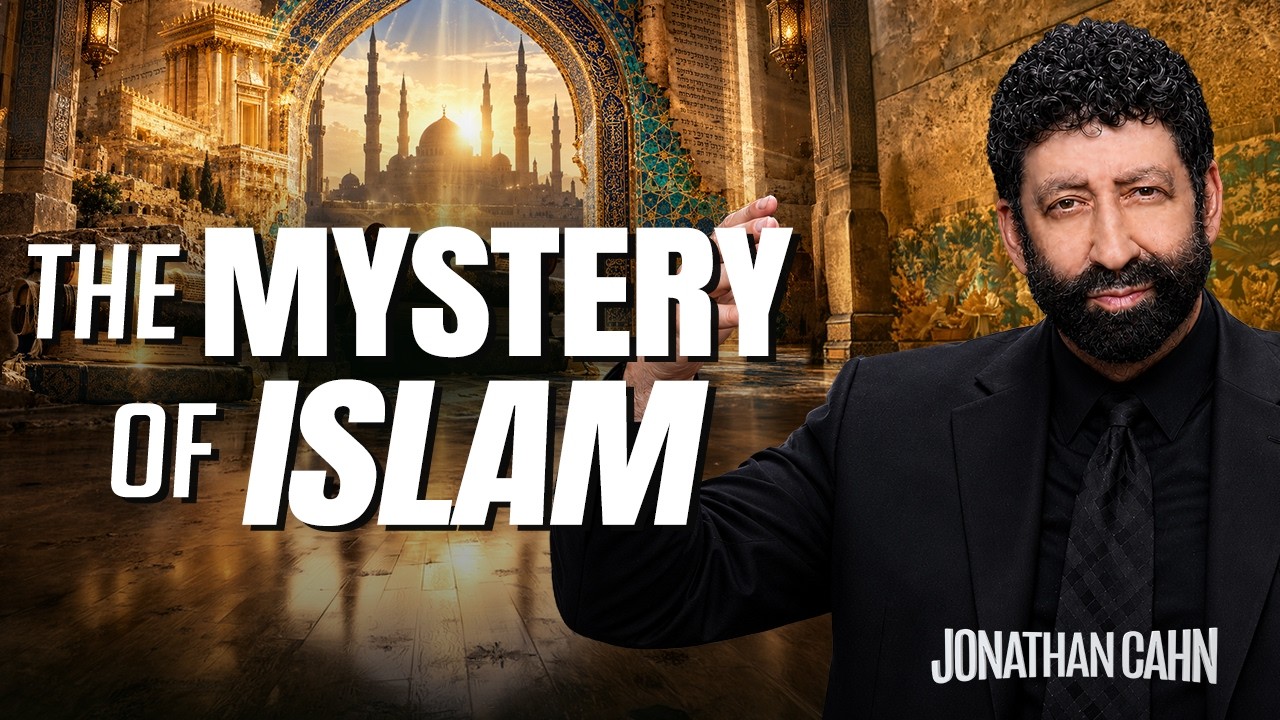
Video Summary: The Mystery of Islam
Cahn begins by noting that Islam would not exist without the Jewish people, because the Quran draws heavily on the Bible. But he says there is a deeper root found in Genesis 15–21: God promised Abraham a son, Sarah gave her servant Hagar to Abraham, Ishmael was born, and then the miracle child Isaac arrived. From this family story, Cahn draws a framework for understanding the long conflict between the descendants of the two sons, his view of the Quran, and a powerful application for anyone living with bitterness or rejection.
Key Takeaways
- Abraham and Sarah tried to “help God” by having a son through Hagar—a decision with consequences for generations.
- Ishmael means “God hears,” and God promised to make him a great nation too.
- Isaac, “laughter,” was the miracle son of promise.
- Cahn sees the conflict as a struggle over the birthright—the land, the blessing and the relationship with God.
- He views the Quran as an appropriation of the biblical story, which he argues contains contradictions.
- Believers are called to understand and love Muslims, praying for healing.
- “The spirit of Ishmael” is living from bitterness, victimhood, jealousy or rejection.
- In Messiah, you are a child of promise—a child of Isaac, not of the bondwoman.
The Tents of Abraham: Ishmael and Isaac
God promised Abraham that he would become a great nation and that through him all the families of the earth would be blessed (Genesis 12:2-3). In Genesis 15:4-5, God reaffirmed that Abraham’s heir would come from his own body, with descendants as numerous as the stars. But as the years passed, Sarah proposed that Abraham have a child through her Egyptian maid, Hagar (Genesis 16:1-6). When Hagar conceived, tension filled the household—and Sarah blamed Abraham for the very idea she had suggested.
The child was named Ishmael—Yishma-El, “God hears”—because God heard Hagar’s affliction. God promised that a great nation would come from him, but also described him as “a wild man” who would live in hostility with his brothers (Genesis 16:11-12). From Ishmael would come many of the Arab peoples.
Then God fulfilled His original promise. Sarah laughed at the idea of bearing a child in old age, and the miracle son was named Isaac—Yitzhak, “laughter.” At Isaac’s weaning feast, Ishmael mocked him, and Sarah insisted that Hagar and Ishmael be sent away. God preserved them in the desert (Genesis 21:8-21). Cahn’s lesson: “Don’t help God out when He doesn’t tell you He needs help.”
Seeing It Through Ishmael’s Eyes
Cahn asks listeners to imagine Ishmael’s perspective. For about thirteen years he was Abraham’s only son and presumed heir. Then a new son arrived—the son of Sarah, not of the servant—and Ishmael was sent away from his father. It would have felt like losing his identity and birthright. Cahn suggests that this could naturally produce rejection, jealousy, anger and resentment.
In Cahn’s interpretation, this ancient wound helps explain the intensity of the conflict surrounding Israel in the Middle East: a struggle over the birthright of Abraham—the land, the blessing, and the calling. He believes this is why tiny Israel draws such disproportionate hostility.
Cahn’s View of Islam and the Quran
Isaac received more than tents and land—he received the covenant relationship with God and the line through which the Scriptures and the Messiah would come. Cahn’s thesis is that Islam represents Ishmael claiming his own version of that inheritance: “I will have my own Bible.” He notes that Islam spread rapidly by military conquest in its early years.
Cahn then reviews passages from the Quran that he believes reveal confusion when compared with the biblical and historical record, including:
- Zechariah and Mary in the Temple: the Quran depicts Zechariah as Mary’s guardian and finds her in the sanctuary, which Cahn says contradicts how the Temple functioned, where only priests could enter.
- “Jesus, son of Mary”: Cahn suggests this emphasis reflects the heavy veneration of Mary in some churches of Muhammad’s time.
- The crucifixion: the Quran says Jesus was not crucified but it only appeared so, while the earliest Christian writings, such as Paul’s letters, center on the crucifixion and resurrection.
- Jesus as Messiah: the Quran calls Jesus “the Messiah” yet says He was only a messenger. Cahn argues that once Jesus is acknowledged as Messiah—the Redeemer of Israel and the world—He cannot be “exaggerated.”
A Hebrew Blessing in Nigeria
Cahn recounts an encounter in Nigeria when his car was surrounded by a group of Muslim men. Asked what he thought of Muhammad, he pointed out that the Quran calls Jesus the Messiah—and if Jesus is the Messiah, we should listen to what He said: “You must be born again.” At the end, the men asked him for a Hebrew blessing, and he prayed over them.
Loving and Praying for Muslims
Cahn emphasizes that believers should seek to understand and love Muslims, many of whom may be unaware of these deeper roots. He rejoices in Arab brothers and sisters who have come to faith in Jesus. He also notes that in Islam, God is not addressed as “Father,” whereas believers in Messiah are invited to call Him “Abba.” In his view, Ishmael’s deepest loss was the father—and the deepest need is healing through knowing God as Father. Believers are called to pray for that healing.
Are You Living in the Spirit of Ishmael?
Cahn then applies the message personally. If you are born again, you are spiritually a child of promise—”as Isaac was” (Galatians 4:28). But you can still live as if you were driven by the spirit of Ishmael. You may be doing so if you:
- Live in bitterness over what was taken from you.
- See yourself primarily as a victim.
- Define yourself by how others have treated you.
- Live with jealousy over what others have.
- Live in rejection or fear because of past wounds.
- Spend your life trying to prove yourself or earn love and approval.
Those wounds may be real, but carrying them into your identity brings a curse, not a blessing. You don’t have to stay there. In Messiah, you are of the line of Abraham, Isaac and Jacob—a beloved child who can call God “Abba, Father” (Romans 8:15).
For related teachings, read The Template of National Judgment, The Mystery of the Two Witnesses, and The Israel Prophecy of Charles Spurgeon.
Frequently Asked Questions
Who were Ishmael and Isaac?
Both were sons of Abraham. Ishmael was born to Hagar, Sarah’s servant; Isaac was the promised son born to Sarah in her old age. Genesis 16–21 records their story.
What does Jonathan Cahn mean by “the mystery of Islam”?
He uses the story of Ishmael and Isaac as a biblical framework for understanding the origins of Islam and the conflict over Abraham’s birthright, while calling believers to love and pray for Muslims.
What is “the spirit of Ishmael”?
Cahn uses the phrase to describe living from bitterness, rejection, jealousy or a victim mindset—rather than as a beloved child of God and heir of His promises.
Final Thoughts
The story of Abraham’s two sons still echoes in world events, but it also speaks to every human heart. Whatever has been taken from you, you don’t have to live in the wound. In Messiah you have been given a Father, a birthright and a promise. Pray for those still searching for the Father’s love—and walk in yours.
