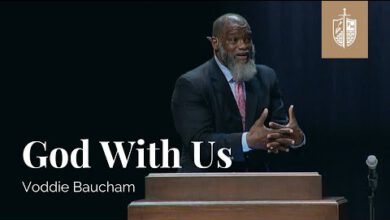
The Mind of Christ in the Believer | Dr. Voddie Baucham | Grace Conference NZ 2025 (Session 1)
The Christian walk is one of continual growth, challenge, and transformation—and at the heart of this journey is a calling to embrace the mind of Christ. Many believers know Philippians for its memorable verses and encouragement, but fewer take the opportunity to deeply reflect on the mindset it calls us to develop. As we dive into Paul’s message to the Philippians, we’ll explore what it truly means to possess the mind of Christ, how this impacts our lives and relationships, and why unity in Christ is fundamental for every follower. Let’s unpack these truths and discover how they guide us into a more Christ-centered, gospel-shaped life.
Connecting with Philippians: Familiar Words, Deep Meaning
Chances are, if you’ve grown up in church or been involved for some time, you’ve heard passages from Philippians quoted or memorized—“For to me to live is Christ, and to die is gain” (Phil 1:21), “Rejoice in the Lord always” (Phil 4:4), “I can do all things through Christ who strengthens me” (Phil 4:13), and “My God shall supply all your needs according to his riches in glory in Christ Jesus” (Phil 4:19), just to name a few. While these verses inspire us, it’s crucial to understand the context in which Paul wrote them—especially when considering what it means to have the mind of Christ.
Paul encourages believers not just to live according to isolated verses, but to shape their entire thought life and character after Christ. This isn’t about just quoting Scripture for comfort, but about continuing in Christ’s purposes and perspectives, allowing our minds to be renewed, transformed, and directed by His Spirit.
What Is the Mind of Christ?
At its core, having the mind of Christ means aligning our attitudes, reactions, and desires with those of our Savior. Paul calls us to think Christ’s thoughts after Him—to be shaped so profoundly by His presence that our approach to life, relationships, and trials is molded not by culture or flesh, but by deep communion with Him.
In Romans, Paul urges us to avoid conformity with the patterns of the world and to be transformed by the renewing of our minds. But how do we actually put that into practice? We do it by seeking Christ’s perspective, by allowing Scripture and God’s Spirit to change how we view ourselves, others, and the challenges we face.
We Learn from Mature Believers
Often, God uses mature Christians in our lives to model this transformed mindset. Many of us can recall a friend, mentor, or elder in the faith who, when faced with difficult circumstances, brings God’s Word—not just as a quick answer, but as an applied, in-season word. They approach problems biblically, offering godly wisdom rather than something shaped by mere human reasoning.
This is the essence of the mind of Christ. Instead of switching our “Christian hat” on and off, we are continually called to approach all of life from a Christ-centered perspective, regardless of how much the world’s solutions might appeal to our flesh. The answers the world gives—a focus on self-fulfillment or shallow therapy—fail to deal with the deeper need for spiritual renewal and gospel truth.
Unity in the Body of Christ
Paul writes to the Philippians to encourage unity—for the sake of the gospel and for the health of the church. The church at Philippi was generous, faithful, and supportive, yet Paul saw a danger: without unity rooted in the mind of Christ, everything could unravel.
He begins, “If there is any encouragement in Christ, any comfort from love, any participation in the Spirit, any affection and sympathy…” In other words, if you are indeed in Christ—and all these things are true for you because of Him—then your calling is to complete his joy “by being of the same mind, having the same love, and being in full accord and of one mind.”
Why Is Unity So Important?
This is much more than organizational harmony; it is supernatural oneness. Drawing from Jesus’ high priestly prayer in John 17, we see that the unity of believers is a direct reflection of the unity of the Father and the Son. Christ’s desire is that His people would be one, not in a superficial sense, but through a mystical, redemptive bond brought about by the Spirit.
This unity is anchored in the incredible truth of the covenant of redemption: before the foundation of the world, the Father gave a people to the Son as a love gift, the Son redeemed them with His life, and the Spirit unites them to God and each other by applying that redemption. The church is meant to showcase this unity, reminding us that our deepest relational connection is found in Christ and what He accomplished for us.
Practical Commands for Shaping Our Mindset
Paul doesn’t leave us with abstract principles—he gives explicit instructions as to how believers are to live out this unity and Christlike mindset:
- Do nothing from selfish ambition or conceit
- In humility count others more significant than yourselves
- Let each of you look not only to your own interests, but also to the interests of others
Notice the balance: Paul isn’t promoting self-neglect, but rather an outward, others-oriented approach that mirrors Christ’s humility and love.
The Battle with Selfishness
Every human heart—yes, even the redeemed—is naturally inclined toward selfish ambition. Even after salvation, the fight against self-centeredness continues throughout the lifelong process of sanctification. God may miraculously deliver us from certain sins in an instant, but typically, most of what plagues us is worked out over many years as we grow to be more like Christ. Our progress in humility and selfless love is gradual, and our ongoing battle with pride and self-interest keeps us reliant on grace.