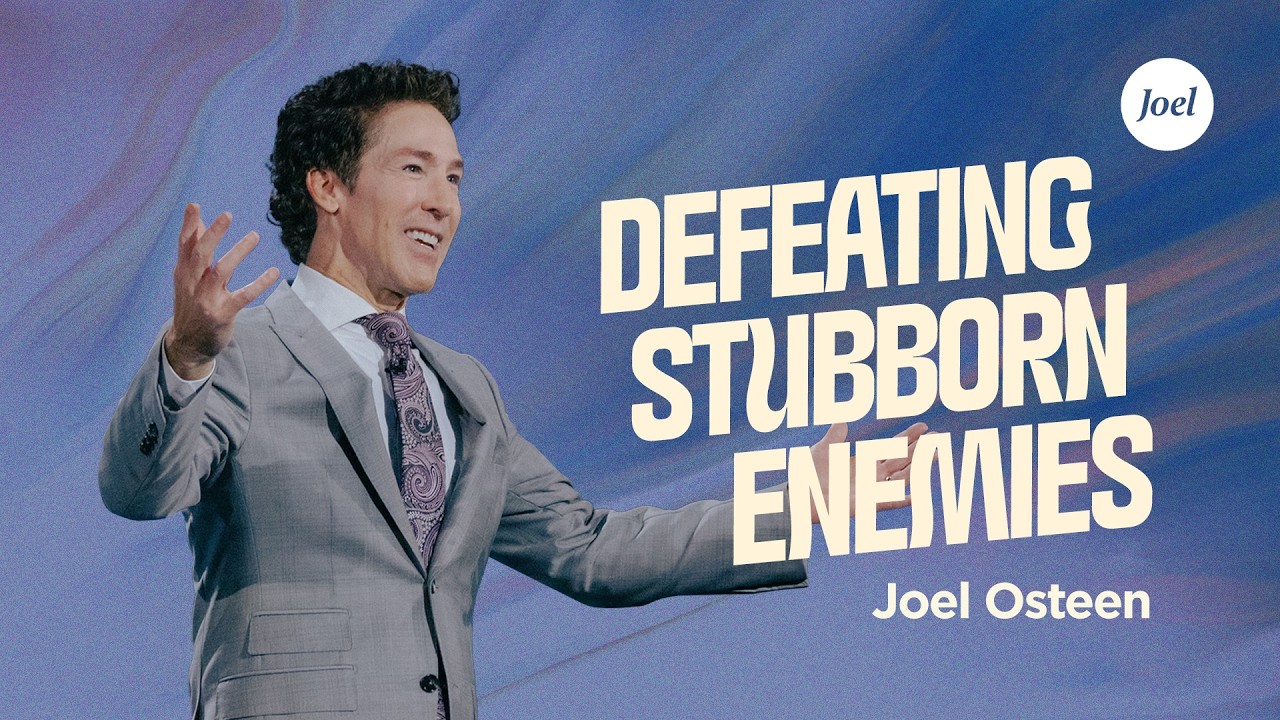
Defeating Stubborn Enemies | Joel Osteen
In this faith-building message, Pastor Joel Osteen speaks to anyone facing a problem that simply will not move. Using the Old Testament picture of Sisera’s 900 iron chariots, he teaches how believers can begin defeating stubborn enemies such as long-term sickness, addiction, generational dysfunction, or depression, by refusing to live intimidated and remembering that no “iron chariot” is stronger than the God who made the promise.
Video Summary
After a lighthearted opening joke and the Lakewood Church Bible confession, Joel Osteen introduces his theme. Most believers have areas where they fight the good fight of faith and win. But there are also obstacles that do not go away easily: a habit passed down through a family, a sickness that has lingered for years, an addiction, or ongoing depression. These “stubborn enemies” can seem permanent, and it is easy to learn to live with them.
Osteen identifies intimidation as one of the enemy’s greatest weapons. The enemy does not have more power, he says, but if he can convince people that a problem is too big, they will shrink back and settle. Quoting Paul’s encouragement not to be terrified by adversaries, Osteen urges listeners to draw a line in the sand.
He then tells the story of Israel’s struggle against King Jabin of Hazor and his commander Sisera, who had 900 iron chariots while Israel had none. He connects this to Joshua’s earlier promise that Israel would drive out the Canaanites even though they had iron chariots, and to the victory under Deborah and Barak when God sent a flood that rendered the chariots useless. He closes with a declaration of breakthrough and an invitation to receive Christ.
Key Takeaways
- Some problems are “stubborn enemies” that do not leave after one prayer.
- Intimidation is one of the enemy’s main weapons; he does not actually have more power.
- Iron chariots represent things that seem permanent, unbreakable, and unbeatable.
- Faith does not deny reality; it recognizes that God is greater than the reality.
- The battle is not “iron versus you,” but “iron versus Almighty God.”
- God can turn the very terrain against what has been holding a person back.
Stubborn Enemies and the Weapon of Intimidation
Joel Osteen acknowledges that every believer faces some areas that are harder than others. People pray and believe, yet the problem does not move. Over time, they begin to think, “This is just how it is.” According to Osteen, that is exactly where the enemy wants them. He reminds listeners of Paul’s words in Philippians 1:28, encouraging believers not to be terrified by their adversaries.
When people stop being intimidated and start seeing through eyes of faith, Osteen says, they realize that “greater is He who is in you than he who is in the world,” as 1 John 4:4 declares. That shift moves them out of mediocrity and into forward motion, and that is when God steps in to help them conquer what once looked permanent.
Nine Hundred Iron Chariots
The main illustration comes from Judges 4:1-3. After entering the Promised Land and seeing Jericho fall, the Israelites still faced the powerful city of Hazor. For twenty years its king oppressed them, and his commander Sisera was feared throughout the region because he had 900 iron chariots. Israel had none.
Osteen explains that chariots were the most advanced weapons of the day. The gap was like one army having tanks and fighter jets while the other had only foot soldiers. He also notes the significance of iron: it seemed unbreakable and permanent. In the same way, the iron chariots in people’s lives are the issues that appear too strong to overcome.
Joshua’s Bold Promise
Osteen then points back to Joshua’s words to the tribes of Joseph in Joshua 17:18: “You shall drive out the Canaanites, though they have iron chariots and are strong.” Joshua did not deny the facts. He admitted that the enemy had better weapons and more technology. But he declared God’s promise anyway. He did not say “maybe” or “good luck.” He said, “You will drive them out.”
Osteen draws the lesson clearly: faith does not deny reality. The iron chariots were real and intimidating, but they were never stronger than the God who promised the land. Israel saw the chariots and thought, “This is too much for us.” Joshua saw the same chariots and thought, “This is too much for us, but not too much for our God.”
Not a Fair Fight
One of the most encouraging moments in the message is Osteen’s reminder that the fight is not fair, but not in the way people fear. When God is on a believer’s side, the odds are in their favor. He lists the God who parted the Red Sea for Moses, stopped the sun for Joshua, brought down Goliath through David, surrounded Elijah with chariots of fire, and provided a coin in a fish’s mouth for Peter. He adds personal testimonies, including his mother’s healing from cancer and the church’s acquisition of its building. “You and God are a majority,” he says.
When God Floods the Valley
In the story of Deborah and Barak, Israel finally went down into the valley to face Sisera. According to the song in Judges 5:20-21, the heavens fought and the torrent of the Kishon swept the enemy away. Osteen describes this as a flash flood that turned Sisera’s greatest advantage into a liability, as heavy iron chariots became stuck in the mud.
He applies this to modern struggles: God can send a “flash flood” of favor and power that breaks addictions, heals sickness, and restores families. But believers must do their part and not stay “up in the hills” where it is comfortable. He closes by declaring that every iron chariot is on its way out and by inviting viewers to pray to receive Jesus as Lord and Savior.
For more from Joel Osteen, read Great Faith Is In You and Dare to Believe.
Frequently Asked Questions
What are “stubborn enemies” according to Joel Osteen?
They are long-standing problems such as sickness, addiction, generational habits, insecurity, or depression that do not go away easily and seem permanent.
What do the iron chariots represent?
They represent obstacles that appear unbreakable and too powerful to overcome, like Sisera’s 900 iron chariots in Judges 4.
Does faith mean ignoring problems?
No. Osteen says faith does not deny reality; it acknowledges the problem but trusts that God is greater than it.
Final Thoughts
This message is a call to stop living intimidated. Joel Osteen encourages believers to look honestly at their iron chariots and then look higher, to the God who has never lost a battle. What seems permanent can be broken, and what has held people back for years can be swept away when God moves on their behalf.
